

Hall of Famer Blyleven still teaching at Twins spring training camp
It was 39 years ago that the Hall of Fame pitcher Bert Blyleven took the mound for the Minnesota Twins against the St. Louis Cardinals in Game 2 of the 1987 World Series.
Armed with a fastball-curveball mix that led to the fifth-most strikeouts (3,701) by a pitcher in baseball history, Blyleven pitched so quickly that after a little more than an hour and a half into the game, he exited after throwing seven innings and limiting Hall of Fame Manager Whitey Herzog’s club to two runs. The seventh inning ended for Blyleven after his Hall of Fame centerfielder Kirby Puckett threw out Jose Oquendo at third base to stop a Cardinals rally.
Blyleven would get the win, striking out eight batters on six hits and two runs. The win was a crucial one for the Twins, who went up 2-0 and ended up winning the series in seven games. Blyleven also pitched in Game 5, where he took the loss after allowing two earned runs on seven hits, over six innings.
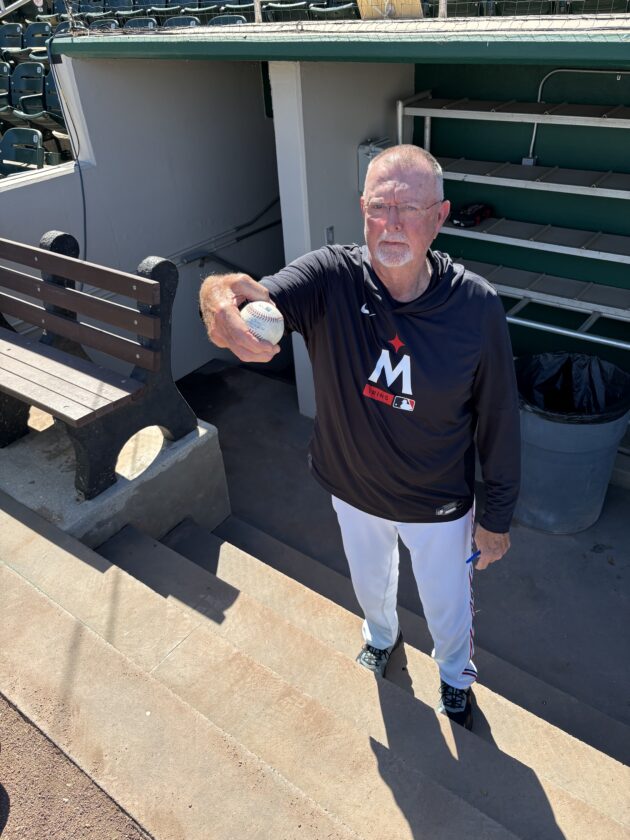
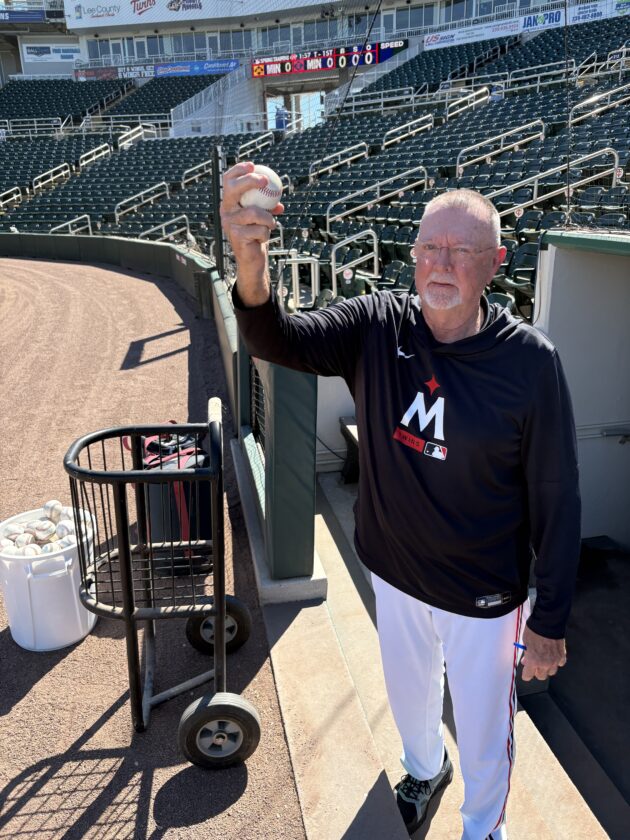
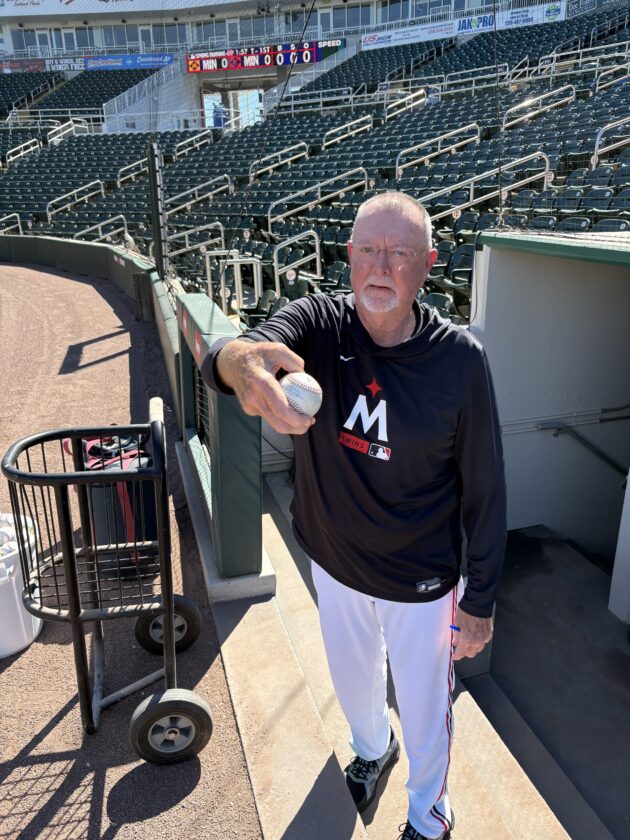
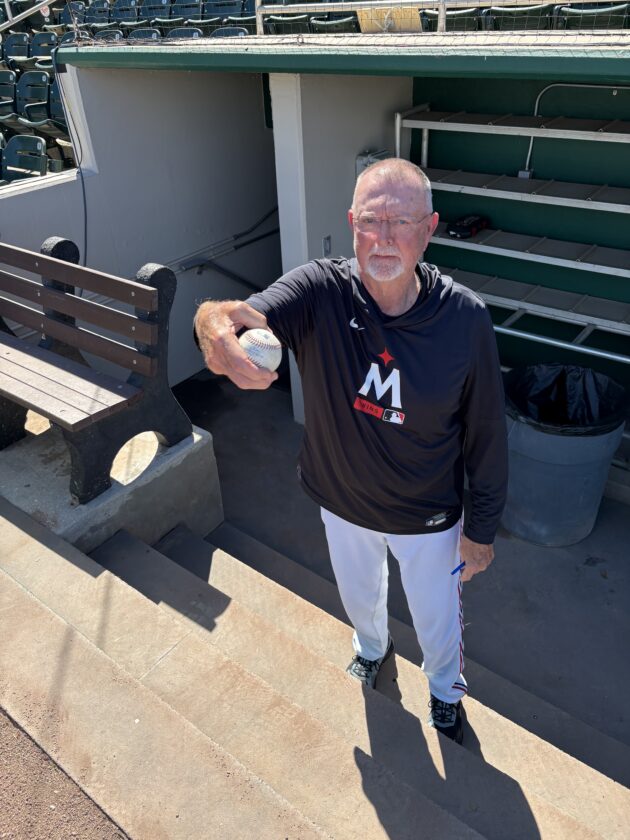
Now, the 75-year-old is working with Twins pitchers at spring training in Fort Myers to help the staff as they work to prepare for a season in which they will be counted on to lead a team that has gone through a lot of turnover.
“I have the honor to come down here and be part of the Twins organization,” the former pitcher and broadcaster said. “I am big on mechanics, as far as the way they go about their business. I don’t get into their routines as far as the weight lifting and all that stuff.”
Blyleven, who now calls Fort Myers home, will tell the Twins coaches first if he sees something he thinks can help.
Working with one of the Twins right-handed pitchers recently, Blyleven guided him to close his left foot so that his feet and legs are level with his shoulders so he isn’t as spread out and he doesn’t have to reach back as much in his delivery. “When you are out there, your adrenaline is flowing and you have to find yourself a way to slow down,” Blyleven said. “This way you just have to bring your leg up and now you drive.”
It was his curveball that got Blyleven into the Hall of Fame and which flummoxed Cardinals hitters in the 1987 World Series and Orioles hitters in the 1979 World Series when he was with the Pirates.
Blyleven said he told himself three things when he pitched: stay back, stay tall, work out front. “I wasn’t a Tom Seaver that went down,” Blyleven said.
“I am old school. I pitched for 23 years. I was taught a certain way. We, on the fastball mainly, went east to west (inside and outside) and now a lot of the analytics they go north to south. I still have a tough time with that because I still think the best pitch for a pitcher is a good fastball down and away on the black. It is the hardest pitch to hit.”
Blyleven said he knows that from having played with many Hall of Fame hitters over his career.
“I talked to Harmon Killebrew, (Rod) Carew, Tony Oliva, guys that I played with, Willie Stargell and I said ‘what is the toughest pitch to hit?’ They said ‘a good fastball down and away with something on it,'” Blyleven said. “You have to work all four corners of the plate.”
Byleven threw 60 shutouts in his career, placing him ninth on the career list and just one less than contemporaries Nolan Ryan and Tom Seaver. That kind of success has left Blyleven with a good idea of how the game should be pitched. Ask him about pitching and he starts breaking it down as a science, almost like Ted Williams would talk about hitting.
“How do you make that 17-inch plate become a 23-inch plate? By hitting the corners,” he said.
Blyleven makes a reference to the new robotic umpire ABS challenge system which will now be judging pitchers on occasion, rather than the umpires themselves.
“Even this machine that they have now, if you put the ball just a little bit, which is about a three-inch baseball, you put it on the corner and you hit it and the other two and a half inches is on the outside corner but that half an inch is in the strike zone. Basically you are turning that 17-inch plate into a 23-inch plate if you can hit your spots,” Blyleven explained.
“I was known for my curveball,” Blyleven said. “But everything keyed off my fastball with location. Two-seamer down and away on a lefty, four-seamer to a righty.” Blyleven said he thinks today’s radar gun is a little faster but thinks his fastball averaged 93-95 miles per hour at his peak velocity in the 1970’s. He described his curveball as a mid-80’s pitch. “I held it just like a four-seam fastball,” he said. In the late 80’s as his career winded down, his fastball sat closer to 90 mph but he was still able to be effective, having one of his best years in 1989 with the Angels when he went 17-5 with a 2.73 ERA.
Blyleven was called up to the majors by the Twins as a 19-year-old in 1970 and was successful right away. In the postseason that year, he was called upon for relief in the American League Championship Series, throwing two shutout innings against the Orioles, though the team lost the series. He recorded more than 200 strikeouts in six of his first seven seasons while also carrying an ERA of 3.00 or lower in six of those years. He was traded to the Texas Rangers in the 1976 season, beginning a journey that would land him on five teams, including two stints with the Twins.
In his career, he did not only post great regular season stats, with eight 200-strikeout seasons and 287 wins, he was also a winning pitcher in the postseason with a 2.47 ERA. He went 5-1 in the postseason, including a 2-1 record over four World Series games pitching for the Twins and Pirates.
In the 1979 World Series with the Pirates, he started Game 2 and Game 5 against the Orioles, both games which were won by the Pirates. Blyleven picked up the win in Game 5 after throwing four scoreless innings.
That Pirates team was led by Hall of Fame hitters Dave Parker and the team’s captain Willie Stargell. Parker, who was inducted into the Baseball Hall of Fame last year, was “a great athlete, a great clubhouse presence,” Blyleven said. “He and Willie Stargell were 1-2. They were our leaders, led by a great man in (Manager) Chuck Tanner.”
Blyleven compared Stargell to another Hall of Famer, his late Twins teammate Harmon Killebrew.
“Stargell was like Harmon Killebrew. That’s all you have to say. People admired Harmon for the person he was and that was Willie Stargell. Willie was a great man and so was Harmon,” Blyleven said. “Willie was more outspoken, he was more of a fun-loving guy. Harmon was a guy that I think goes to work from 9-5 and does his job and goes home and has dinner,” Blyleven said. “Harmon loved ice cream, hot fudge sundaes.”
One of the overlooked players on the team was their four-time batting champion Bill Madlock, who only appeared on one ballot of the Baseball Hall of Fame despite a career .305 batting average with 2008 hits.
“He was an awesome hitter. He could hit to all fields,” Blyleven said of Madlock. “He didn’t have the power, he didn’t go looking for home runs. He was always on base, scoring runs, drove in runs. He was a very consistent third base.”
Blyleven mostly would switch off between two-seam and four-seam fastballs and then said he would use his curveball as a changeup. He developed a cutter later in his career to get inside on lefties as his fastball started tailing back. He picked it up from Don McMahon, his pitching coach with the Cleveland Indians between 1983 and 1985.
Blyleven said he focuses on the release points of the pitchers he works with on the Twins. “We were taught to release the ball out front,” Blyleven said. Blyleven said the bullpens that pitchers do in between starts is important to ensure they don’t pick up bad habits.
Though Blyleven won that second World Series title in 1987 with the Twins, it nags him a bit that he led the league in homers in 1986 and 1987. There is wide belief that the ball was changed in those two years, or “juiced.”
For example, in 1985 there were only three pitchers who allowed 31 home runs or more (Blyleven allowed 23) In 1986 there were 10 players that allowed 31 homers or more with Blyleven at the top with 50 (more than doubling his career high). In second, was Hall of Fame pitcher Jack Morris with 40. Morris would enter Twins lore in 1991 with his 10-inning shutout in Game 7 of that year’s World Series. In 1987, there were 10 pitchers who allowed 35 homers or more.
Yet in 1988, Blyleven went back down to only allowing 21 homers and there were three players who allowed 31 homers or more, with nobody exceeding 36.
Asked about this, Blyleven said “I thought the ball was juiced (in 1986 and 1987) because I had already had pitched 14 years prior to that.” Blyleven said “I shook my head a lot in those years,” Blyleven said. Balls he thought were hit hard enough to go to the warning track were going deep into the stands. Fortunately for him in 1987, 34 of the 46 homers hit off him were solo shots.
He credited the offense around him on the Twins in picking him up in 1987 when the team won the World Series over the Cardinals. “I had Hrbek and Gaetti and Puckett and Brunansky. I had to take the good with the bad,” he said.
When he retired from the game, Blyleven was third on the career strikeouts list, trailing only Nolan Ryan and Steve Carlton. “I never considered myself a strikeout pitcher like Nolan Ryan or Randy Johnson or Steve Carlton,” Blyleven said. “It was an honor but I took more pride in complete games and shutouts.”
Complete games, Blyleven said, “Was important to me. I always considered myself he workhorse of every staff.” In his early years, that meant starting every fourth day.
Blyleven credited his long-distance running in helping his endurance and longevity. “I think no matter what sport you play, your legs are your strength,” he said. “I always considered my arm nothing more than a whip. If my legs got out too far, the whip couldn’t catch up. It’s a balance over the pitching rubber to allow that arm to whip through.”
Blyleven said he only did some light lifting during his career. “I did a lot of yoga, a lot of the stretching and all that stuff,” Blyleven said.
When Blyleven was called up, he pitched with Hall of Fame pitcher Jim Kaat and Cy Young Award winner Jim Perry and picked up on their workout habits. He also credited watching Nolan Ryan and Hall of Famer Catfish Hunter’s stretching routines before games in helping him.
Blyleven said he believed in the power of positive thinking, which helped get him through rough stretches.
That way of thinking was ingrained upon him by his parents who immigrated here from Holland via Canada. Blyleven in Dutch means “happy life” and Blyleven was the first Netherlands native to be inducted into the Baseball Hall of Fame.
Blyleven and his family left the Netherlands when he was two-years-old. He spent four years in Canada where his dad Joe and mother Jenny worked on farms. They moved to California when he was six, with his dad working in the auto body repair business. “The first time I saw indoor plumbing was when I was six-years-old,” he said.
Growing up around Garden Grove, he had a paper route and discovered Little League baseball. He started up as a catcher because his family couldn’t afford baseball equipment and each team had their own catching equipment. His coach, a firefighter, gave him a glove which led to him becoming a pitcher.
He taught himself to throw his legendary curveball by listening as a kid to radio announcer Vin Scully describe the drop from the great Dodgers Hall of Fame curveball thrower Sandy Koufax. His dad heard Koufax get interviewed by Scully regarding his arthritic elbow, with Koufax saying he didn’t think kids should throw a curveball until they are 14, which delayed Blyleven’s use of the pitch.
When he heard Scully describe the drop on the curveball of Koufax, he soon started spinning the ball off a cinder block wall on the side of his house. “I put a strike zone on that wall in chalk and I would throw it over and over,” Blyleven said. “I started spinning the ball and that became my curveball,” he said.
Blyleven said it’s important that a young pitcher wait to throw the curveball because the arm is still growing during the teenage years. “You have so many areas in your elbow that you can stretch out and end up hurting,” Blyleven said.
Blyleven would face a forearm injury in 1982 that started in his funny bone and ended up in his forearm and in surgery, causing him to miss nearly the whole season. He would enjoy one of his best seasons after the surgery in 1984, when he went 19-7 with a 2.87 ERA. In 1985, he led the American League with 206 strikeouts pitching for the Indians and Twins.
In his two and a half seasons with the Texas Rangers, Blyleven was a teammate of the late Hall of Fame pitcher Gaylord Perry, who was notorious for his use of the outlawed spitball.
Perry wanted to learn Blyleven’s curveball and Blyleven showed him. “He picked it up pretty good. I said ‘OK Lord what do I get out of it?’ So in between starts, he showed me the spitter, where he had it, the sinker and all that. I was like a kid in a candy store. I threw it and the next day my elbow was barking. You throw it without seams so it slips out of your hands.”
The two became very good friends. “We both had the goal of going to that mound and finishing it.”
Blyleven threw hit lone no-hitter with the Rangers and calls Rangers catcher Jim Sundberg one of his favorite catchers along with longtime Twins catchers Phil Roof and Tim Laudner.
On baseball players he would like to see go into the Hall of Fame, Blyleven mentions Tommy John. “With Jim Kaat in there, Tommy John should be in there. You hope these guys are still with us when their names are called.”
Blyleven was on the Hall of Fame veteran’s committee a couple times. Blyleven would like to see former Manager Lou Pinella get into the Baseball Hall of Fame as well as former Blue Jays and Mets slugger Carlos Delgago.
Blyleven waited 15 years to get into the Hall of Fame. “I got frustrated because my numbers were there,” he said.
Blyleven said he looks at Clayton Kershaw, Max Scherzer and Justin Verlander, three of the current pitching greats who are shoe-ins to get into the Baseball Hall of Fame, and finds it hard to compare himself to them. Combined, their 29 shutouts are less than half of the 60 shutouts Blyleven completed.
Blyleven doesn’t have an issue with the way pitchers lift more weights these days. “There are so many strength coaches in there, if they lift the weight there is somebody to tell them how to do it correctly. I don’t have a problem with that. Everybody has to know their own body,” he said. “I was loosey goosey. I relied on flexibility.”
The Twins started off on the wrong foot this spring training, losing frontline All-Star pitcher Pablo Lopez to season-ending elbow surgery. Lopez was known for his strong workout habits, which included running and lifting.
He is not sure of today’s methods of training and managing pitchers is better than before.
“You look at these pitchers today, they get fed a lot of information, they have the videos now that break down every movement. Is it too much? You can’t put everybody under one hat. The 100 pitch count, we never had a pitch count” Blyleven said.
He finds it “sad” to watch pitchers leave after six or seven innings when they are throwing shutout ball.
He believes more pitchers are getting hurt by chasing higher velocity. “They are all trying to throw 100 miles per hour,” Blyleven said. “So many times, I watch the game its 0-2 (pitching count), next time its 3-2. Why? It’s 0-2. Trust your stuff,” he said.
Blyleven was an ultra-quick worker so the new pitching clock wouldn’t have bothered him at all. He isn’t worried about the effect of the pitching clock on pitching arms today. “They have 15 seconds. It’s plenty of time,” he said.