

Brady answers Fort Myers Beach Observer questions on London Bay, public benefit
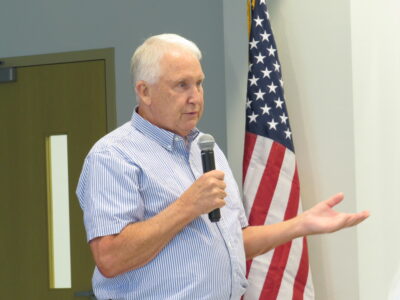
Protect FMB President Tom Brady is seeking a four-year seat on the Town of Fort Myers Beach Council in the Nov. 3 election. Brady answered the following questions from the Fort Myers Beach Observer as the first part of our questions of the week for town council candidates:
Name: Tom Brady
Age: 74
Place of birth: Alexandria, Virginia
Where did you grow up and living before moving to Fort Myers Beach: Grew up in northern Virginia, and Saipan in the Marianas Islands. I’ve lived in New Jersey, North Carolina, Michigan, Tokyo, and Munich, Germany.
Education: AAS Electronic Engineering Technology (candidate did not identify place of learning)
When did you move to Fort Myers Beach? 2018
What is your current job, occupation or business? Retired
Career: I spent my career in executive leadership in information technology, primarily in engineering computer systems, managing large global organizations and operations.
Political experience: None. I have never held political office.
Community involvement: Founder and President of Protect FMB, with membership in the Mound House and Fort Myers Beach Woman’s Club.
Question of the week:
Can you comment on your opinion of the original London Bay project and what you think of their latest proposal and use of the Live Local Act? How do you think the town staff should be responding to this Live Local Act proposal? Do you think it fits the town’s comprehensive plan, and if not, what should the town do? How would you act on the Town of Fort Myers Beach Council to respond to this proposal?
Answer:
London Bay’s development proposal sought several variances that adjoining neighbors said would negatively affect their community without providing permanent, enforceable public benefits. Because this proposal could come before me in an official capacity, I will reserve further comment on its merits.
The Live Local Act is an option developers may explore, and I support affordable housing. At the same time, the Town has legal rights of its own, and I expect it to fully defend those rights.
This week’s question for the candidates:
State your opinion on what you think a public benefit should be for a developer, whether town council needs to define public benefit more clearly in the town’s code, and whether you believe any project is entitled to deviations from town code if they can provide a public benefit, or if there should be limits to the amount and size of deviations for a project that proposes public benefit? What do you think the limits on deviations should be?
Answer:
Public benefit must be clearly defined so residents and developers know the rules. Allowing individual Council members to negotiate undefined benefits with developers creates uncertainty and inconsistency, especially when the details of ex-parte discussions with Council or LPA members are not fully disclosed.
Exceptions to our codes should be rare. A legitimate public benefit should be permanent, proportional to the deviation requested, benefit the broader community, and advance an established Town strategic objective. Whenever possible, land offered as a public benefit should be deeded to the Town rather than provided through a temporary or revocable easement. Nearby residents affected by a proposed deviation should also have a strong voice.
Potential benefits might include workforce housing, parks, historic preservation, transportation, or infrastructure improvements.
I also support reasonable limits – a cap on what can be negotiated. If an extraordinary proposal cannot fit within those limits, the Town can consider changing the code through the normal public process.
Residents must be involved to help define what qualifies as public benefit.