

Mayor, Environmental Project Manager clash over turtle lighting ordinance
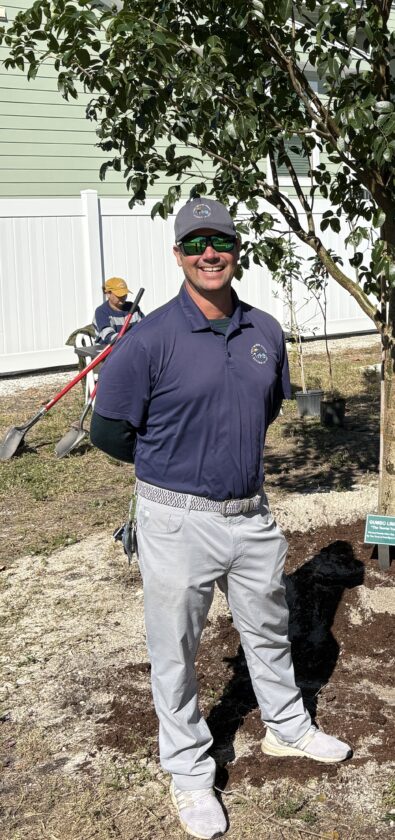
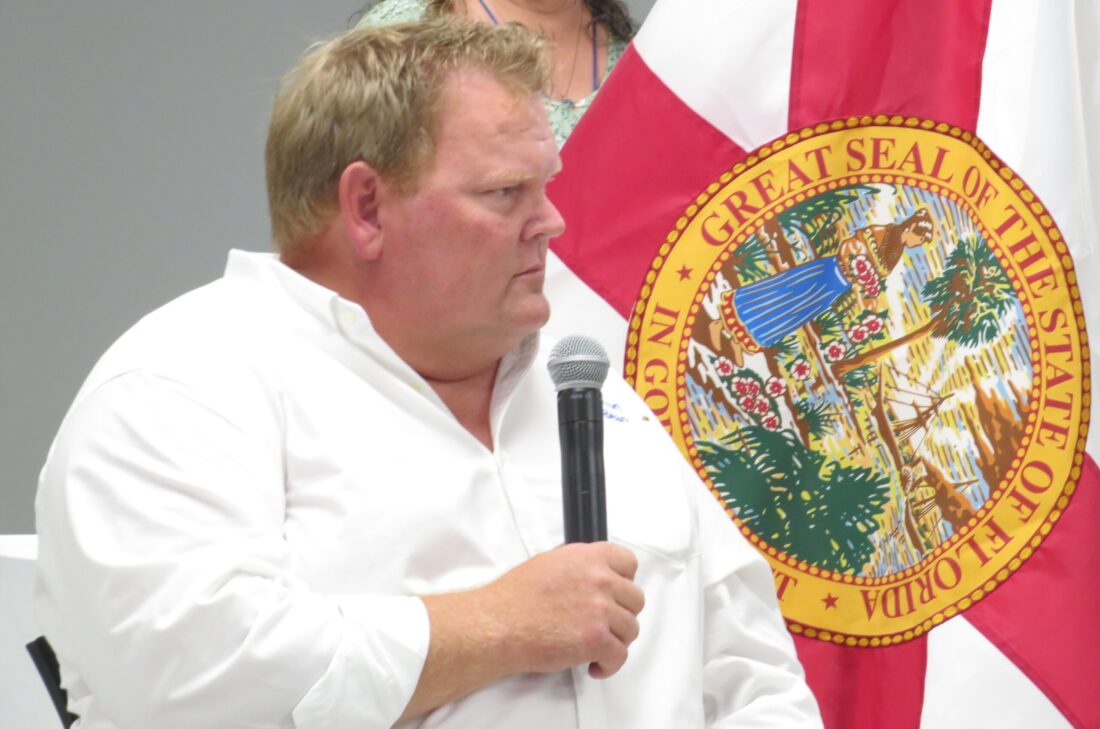
A discussion on the town’s sea turtle conservation lighting ordinance led to clashes between Fort Myers Beach Mayor Dan Allers and Town of Fort Myers Beach Environmental Project Manager Chadd Chustz over arguments Allers made in challenging the town’s lighting ordinance and permit reviews.
The arguments occurred during a planning and management session on Thursday after Town Council scheduled the discussion during the middle of the town’s sea turtle nesting season which has already seen deadly disorientations of sea turtle hatchlings from 15 different nests due to lighting violations.
“I wanted to talk about this because as we are rebuilding, the number one complaint I am hearing about permitting is environmental,” Allers said. “It’s the inconsistencies.”
Allers claimed the town code was subjective for applying to all buildings that may project light to the beach, whether they are beachfront properties or not.
“We all understand the importance of it and why we have to do it but how it is applied, it’s not consistent,” Allers said. Allers said there are delays with permit approvals over lighting plan issues that aren’t beachfront properties.
Chustz and Turtle Time have found that many of the lighting issues facing disoriented turtles are from across Estero Boulevard due to many of the buildings that once stood on Fort Myers Beach, having disappeared since Hurricane Ian, leading to more lights reflecting on the beach from properties on the other side of Estero Boulevard that were once not visible from the beach.
Fort Myers Beach Councilmember Rebecca Link and Chustz argued against the comments by Allers that the code was subjective. The code is based on a state model ordinance.
“That’s definitely not how we apply things,” Chustz said in response to the comments by Allers on the town’s lighting code. “The consistency is if you are directly or indirectly visible from the beach, you (outdoor lighting) have to be long-wavelength, downward-directed and shielded.”
During sea turtle nesting season from May 1 to Oct. 31, the town’s sea turtle lighting ordinance prohibits outdoor lighting at night unless it is shielded, long-wave amber lights that are downward directed. In addition, all screens and blinds must cover windows from 9 p.m. to 7 a.m. The town has issued dozens of warnings for violations of the code this season.
Fort Myers Beach Councilmember John McLean said he received an email from a beachfront property owner who put in windows that weren’t tinted on the side, not expecting to cause lighting issues.
McLean expressed being personally surprised by the town’s lighting code being part of the review in relation to the rebuilding of his pool, which is four houses from the bay and on the canal. “There were lighting standards that went into (the review), McLean said. “That was part of the review process,” McLean said.
“You will be amazed at some of the light shows you see coming out of pools these days,” Chustz said. “Just recently I had a house that was on the other side of Estero by maybe three lots and it was an absolute light show, and it was bouncing off the two or three-story house.” Chustz said that such light reflection is part of “runaway lighting” which can cause disorientations of sea turtle hatchlings.
In fact, Turtle Time has had to recover sea turtle hatchlings out of pools in the past, after they were drawn away from the Gulf and towards light reflecting off the pools.
The lighting issues on the other side of Estero Boulevard disorient turtles and send them away from the Gulf and towards Estero Boulevard where they see light. This week, a dead sea turtle hatchling was found in a storm drain at the town’s Waistina Way parking lot, by Turtle Time.
Allers argued against requiring homes and businesses that are not on the beach to be held to the same standards as homes on the beach. Allers claimed the lights from his home wouldn’t be visible on the beach. “Why should a construction of a property be held up?”
Allers said construction of a property shouldn’t be held up over its outdoor lights. “What is approved, should be approved,” he said. “Why are we holding up people?”
Asked after the meeting by the Fort Myers Beach Observer to identify specific examples of where there were delays with permitting related to the town’s lighting ordinance, Allers declined.
Allers said “there have been a number of properties that have experienced delays during the lighting review process. Rather than identifying individual properties, I think the large issue is the process itself.”
Fort Myers Beach resident and Turtle Time volunteer Cindy Johnson, who works closely with the town on the turtle lighting issues, said the comments from Allers were “really disappointing.”
Speaking on Tuesday when Turtle Time reported its 15th nest disorientation on Fort Myers Beach out of just 36 to hatch due to an unusually rough season for loggerhead sea turtles on the island, Johnson referred to the deadly consequences that the disorientations have caused for hundreds of young hatchlings this season.
“Not one of the 31 hatchlings (from the disoriented nest on Tuesday) that crawled out of the nest headed straight to the Gulf. Instead, a few crawled from just south of Sterling Avenue, over the berm to the Sterling access. The remainder crawled north to Dakota and south to Aberdeen with most heading inland, over the berm. Unfortunately, Town staff and Turtle Time have made contact with these properties more than once this year. In addition, some properties have been contacted in years past,” Johnson said.
“Hundreds of hatchlings from Fort Myers Beach did not make it to the Gulf this year and dozens of hatchlings have been found run over on Estero Boulevard,” she said.
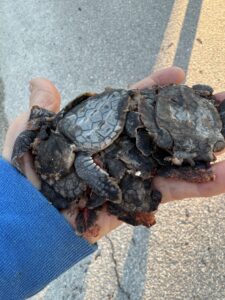
These sea turtle hatchlings were crushed on Estero Boulevard after disorientating from their nest on Fort Myers Beach. File photo
Johnson said she was approached by two separate residents on Tuesday about the lights they were seeing from up and down the beach. “They are wondering why this is allowed,” she said.
Johnson also criticized Allers for suggesting that amber lights are not safe during the offseason.
“As a resident, I find it unfortunate that anyone in Town leadership at this point would insinuate that the amber lighting is unsafe,” Johnson said. “I also don’t understand the statements about not being able to read menus in amber lighting and that people want to see the colors of the food that they are eating at in a restaurant at night. Where are the peer reviewed studies?”
Turtle Time, which is permitted by the Florida Fish and Wildlife Conservation Commission, monitors the sea turtle nesting activity on Fort Myers Beach. The deadly disorientations have been exceptionally frustrating during a season when about 60% of the island’s 103 nests have been washed over and believed to have been jeopardized.
Despite the pushback from Chustz during the meeting in countering the arguments by Allers, Allers persisted in peppering back against the town’s lighting code.
“To me it goes too far down a rabbit hole,” Allers said.
“Lighting does matter,” Chustz said. “Our sea turtles are basically natural light detectors,” he said. “One floodlight can open and they will all go towards that light.”
Chustz said the town has been battling the disorientation challenge since Hurricane Ian due to the increasing open space after many buildings were knocked down.
“We hear a lot on the town staff side, a lot of questions, when it comes to permitting, when it comes to the planning processes, and when it comes back around to code enforcement,” Town of Fort Myers Beach Manager Will McKannay said. McKannay said he recommended Town Council hold a discussion on the issue due to those questions.
At one point, Allers challenged the observation by Chustz of the effects of lights from television sets that are outside on commercial properties, including ones that are on tall buildings that are outside without covers, projecting to the beach. Allers said those include restaurants who want to have more lighting.
“TV’s are the worst light source,” Chustz said. Chustz said he used his spectrometer recently to see how a group of TV’s at a business establishment was reflecting light onto the beach. TV’s have the highest peak on the blue wavelength, which is what sea turtles are most sensitive to, Chustz said.
Allers attempted to challenge the observations of Chustz, comparing it to the measurement of noise. Chustz said the brighter the lights, the increased probability that sea turtles could become disoriented.
Chustz said one of the most recent deadly sea turtle hatchling disorientations was due to TV’s from a bar.
Chustz said the taller and brighter the lights, the more problematic it is for the sea turtles. “It’s difficult to shield a light that is 20 or 30 feet up,” he said.
“We have a lot of fixtures that are under a roof, or under an overhang with no enclosed walls, windows, doors, resulting in non-long wavelengths of full-spectrum light being visible from the beach. This is a big issue for restaurants,” Chustz said.
“If you have lights that are under a roof, but nothing enclosing it, nothing shielding it, we are regarding it as exterior and are reviewing it accordingly,” Chustz said. He said there are a lot of projects being proposed with balcony or under-roof lighting for an outdoor dining experience. There are also requests for dual-lighting schemes being proposed by property owners and businessowners who want to be able to switch their lighting based on whether it is turtle-nesting season, and different lighting the rest of the season. Chustz said the town code doesn’t allow for dual lighting options.
Allers argued for flexibility to allow property owners to change their lights during different seasons for businesses or property owners.
Allers said the town is restricting property owners “to provide the best service to their customers or a resident to provide the most safety to their family through a code because they don’t allow that change.”
Allers said “You have to allow some flexibility in here.”
Chustz said it would be a challenge based on the ongoing non-compliance with the turtle lighting code.
“If it’s not idiot proof, you are going to have some commando that flips a switch,” Chustz said.
Allers said the town’s current lighting ordinance “is tempting people to go against the ordinance because they want to do what they want to do.” Allers said there is going to be “knuckleheads that do knucklehead things.” Allers said he thinks it is just a code enforcement issue.
Chustz said that if the town goes down the path favored by Allers “it strains enforcement. It is impossible to keep up with.”
Since Hurricane Ian, Chustz said the town has been seeing runaway lighting running across the other side of Estero Boulevard.
“One day, I received more than 30 complaints” regarding lighting violations, Chustz said. “They are legitimate.” Chustz said the town has about 80 letters out to property owners regarding turtle lighting violations.
Councilmember John King said he sided with Allers on the lighting. “We can’t go to a dual lighting system because it’s not idiot proof,” King said. “You’ve got humans involved.” King said he didn’t have faith in the Florida Fish and Wildlife Conservation Commission.
Since a record number of disorientations of sea turtles last year that is estimated to have led to the death of thousands of sea turtle hatchlings, Chustz said the town has begun reviewing all outdoor lighting plans during building permit reviews. “It’s being a good neighbor lighting-wise,” Chustz said.
Allers said “because there is a few bad actors on the island that decide they are going to do things that creates dark skies, or creates ambient light up in the sky, everybody should be scrutinized because people don’t do what they are supposed to do.”
Chustz said “it’s not just a few mayor, it’s dozens.”
Allers said he didn’t disagree. “I’m not saying it isn’t but is it safe to say not everybody is doing it?”
Chustz said there are a lot of properties that are high up with white outdoor lights that are visible from the beach.
Allers said he wants to speed up reviews of permits that deals with the town’s turtle lighting code.
Link said she received comments from a local architect who provided her suggestions from how sea turtle lighting is done at Sanibel. “A lot of it is education up front,” Link said. She said the architect suggested lunch and learn sessions, with informational brochures.
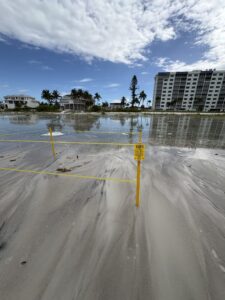
Turtle Time estimated that about 60% of the sea turtle nests on Fort Myers Beach were washed over by rainstorms last month.
McLean said he wanted to find a middle ground to help local businesses and to give them “flexibility” to change their lighting based on the time of day and time of season. “It’s the impact of the light we are trying to manage,” he said.
Allers said his biggest issue was how lighting reviews were holding up projects. Chustz said the town has actually allowed projects to start conditionally while the lighting issues are being worked out between town staff and the property owners.
Allers wants a policy in place. “Maybe it’s commercial,” Allers said. “Are there policies and procedures in place we can have for a bigger development?”
Allers said he wants to “make the exception the rule” to give flexibility to businesses working on projects.
Community Development Director Frankie Kropacek said that town staff informs property owners at the start of the review process what the town code is.
Allers again claimed that projects were being delayed over lighting conditions.
Kropacek said there have been issues with town staff having to explain to developers and their architects the lighting code and the restrictions for exterior lighting. “We have come a long way,” Kropacek said.
Allers said he wants builders and developers to be able to move their projects along quicker even if the lighting conditions have not been approved by town staff.
Johnson applauded efforts by the town to reduce turtle lighting violations but said more work remains to be done. Turtle Time distributes brochures with information about sea turtles and the town’s sea turtle lighting code every year.
For those property owners who don’t have property outdoor lighting for sea turtle nesting season, the answer is as simple as going online to Loew’s or Home Depot and searching for turtle-friendly shielded amber lights that are downward-directed.
“The town really tried at the beginning of the year trying to reduce turtle lighting violations. We have been trying to help them reach their goal,” Johnson said.
Fort Myers Beach Observer Editor Nathan Mayberg can be reached at NMayberg@breezenewspapers.com