

Collins, Donalds, Renner talk the issues in Republican primary for Florida Governor
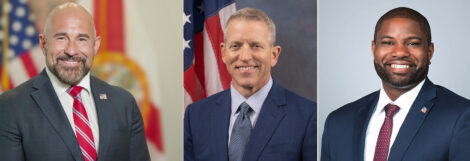
Florida Lieutenant Governor Jay Collins, Congressman Byron Donalds (R-Naples), former Florida Speaker of the House Paul Renner, three of the leading contenders to be the next governor of Florida and succeed term-limited Gov. Ron DeSantis, recently spoke with Breeze Newspapers ahead of the upcoming Aug. 18 Republican primary .
Donalds, whose congressional district covers most of Lee County and Collier County, has been considered the frontrunner in part for the backing of his candidacy by President Donald Trump. Donalds has been a staunch backer of the president.
Donalds voted against certifying the results of the 2020 presidential election in Pennsylvania, and against certification in Arizona in 2021 after the riots at the Capitol.
Collins, 50, a former state senator whose district included Tampa, has been lieutenant governor since being appointed by DeSantis 2025.
Donalds, 47, was elected to the House of Representatives in 2020, succeeding Rep. Francis Rooney (R-Naples). There are now 14 candidates vying to replace Donalds in the 19th Congressional district.
There are 11 Republicans competing in the primary for governor. Collins is suing candidate James Fishback, to have him removed for the ballot for allegedly not meeting the residency requirements for governor. Fishback has received extensive criticism for what other candidates have described as his racist rhetoric. Other Republican candidates in the field include Jim Holcomb, Arthur Joseph McCaffrey, Daniel Nokovich, Rachel Rodriguez, James Shaw, Caneste Succe, and Bobby Williams.
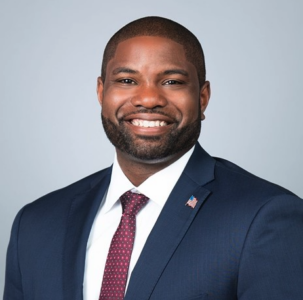
Congressman Byron Donalds, whose district includes Lee County and Collier County, is considered the favorite to win the GOP primary for Governor on Aug. 18. Photo provided
Byron Donalds
Several polls have shown Donalds leading the race. In 2023, Donalds sought to be Speaker of the House during an unsuccessful challenge to former Speaker of the House Kevin McCarthy. McCarthy was later voted out as Speaker of the House and replaced by Mike Johnson. Donalds said he fully supports Johnson. “Speaker Johnson is doing the best job he can but the Senate is just unworkable right now,” Donalds said.
Donalds said he wants to see the Save America Act passed in the Senate, procurement reform for energy, and Trump’s border security bill approved.
“The problem is everything is logjammed in the Senate,” he said.
Donalds said he is running to make sure “Florida remains the best state in all of America. I moved here 30 years ago to go to college. I have been very blessed, have built the Florida dream of my life and I want to make sure that is available to families in our state.”
Donalds said “the next governor needs to have a strong business and economics background.” Before being elected to Congress, Donalds was a state representative and worked as a financial advisor and was an associate vice-president of investments at Moran Wealth Management in Naples.
The congressman said he wants insurance reforms, and wants to “reform the regulatory side to push down insurance costs for homeowners.”
Donalds said he is aware of the struggles that homeowners and condo associations have had in being reimbursed by insurance companies since Hurricane Ian.
“I have been aware since Hurricane Ian,” Donalds said. He wants to put out an insurance scorecard that would give information on how much an insurance company would charge, but would also give information on denial percentages, and the timeliness of fulfilling claims.
After Hurricane Ian, Donalds was hopeful there would be a supplemental bill to help Fort Myers Beach. While a supplemental funding bill wasn’t passed, Donalds said he has been spending a lot of time staying on top of FEMA reimbursements. He is critical of how the agency has responded to the impacts from Hurricane Ian throughout the region, and took part in hearings with FEMA in the county after Hurricane Ian in which he was critical of their response.
Donalds said he was meeting with FEMA just this week on releasing reimbursements for Naples and Sanibel. “We pushed hard with FEMA to get a final sign-off on reimbursement to rebuild the Naples Pier,” Donalds said. He said he is also working on Fort Myers Beach issues regarding FEMA.
“We work very diligently with FEMA, and have quite frankly been on their backs to make sure they release the funds,” he said. “Honestly, it’s a bureaucratic agency that takes way too long to do the basic things. We want to see a reformed FEMA that really empowers Florida.”
Donalds also worked with the Town of Fort Myers Beach in working with FEMA over the town’s release from probation, after FEMA found issues with the town’s permitting procedures and took town residents out of the National Flood Insurance discount problem. FEMA has since announced the town will be put back into the system.
Donalds is supportive of the increase in the homestead property exemption that will be up for a state referendum this November, but said if it doesn’t pass he wants to use the budget commission to make changes to a new bill to ensure there is relief for seniors on fixed incomes and working families.
“I support it, but the question is if it’s going to pass,” Donalds said. He wants a full study of the taxing system and fee structures in the state, and also to “find newer ways to try and capture revenue from the 140 million tourists who come to Florida every year so they can actually help to pay for the services that quite frankly Floridians are paying for today.”
Lee County has estimated it could lose as much as $200 million or more in property tax revenue annually by 2028 if the referendum passes.
“The better question is can Floridians continue to handle a higher level of property taxes,” Donalds said. “The budgets of our homeowners haven’t increased.”
Donalds said Lee County should have gone to a rollback rate. “Now the voters are going to decide,” he said.
Donalds acknowledged that the increase in costs for public schools is also a large part of the tax increases for residents. He said he opposed the lawsuit by the state teacher’s union suing the state over the funding of public schools.
The son of an assistant principal and middle school teacher, who worked in public schools in Brooklyn, his wife now runs a nonprofit that advises new charter schools. Donalds backs school choice.
On the subject of the Fort Myers Beach Elementary School, which has been closed since Hurricane Ian, Donalds was initially involved in discussions between Fort Myers Beach Mayor Dan Allers and Lee County School District Supt. Denise Carlin regarding the reopening of the school. At that meeting, the subject of the school potentially becoming a charter school was raised.
“It’s something that we have been working with Lee County schools and the town with. I think the current path they are on right now, even though the school is closed, is for it to become a charter school that the town can actually manage and run without Lee County schools running it,” Donalds said. Donalds said part of the issue is finalizing the details of the land transfers from the school to the town. “I think there is a way to get that deal finally done to help the kids on Fort Myers Beach.”
On whether he would forgive the state’s $11.9 million loan to the Town of Fort Myers Beach, which was given by Gov. Ron DeSantis after Hurricane Ian to help the town’s operations, Donalds said “it is something we would have to look at. I don’t want to make a commitment without looking at the entire scope of what the governor signed off on.” State legislators had said a couple years ago they believed the loan would be waived, though it has not occurred.
Donalds said he also wants to reform permitting and planning regulations, “so you can decrease the government side hat does add to costs when it comes to building new homes.”
Told that overdevelopment concerns have become a top issue in a county commissioner race, Donalds said he has heard those concerns but that the issue is “county government has not kept up with road infrastructure and quite frankly neither has the state Florida.”
Donalds said many citizens are “concerned about growth because commute times, transportation times and quality of life is decreasing because of congestion and traffic.”
Donalds said Southwest Florida needs a “growth management plan so we know how Southwest Florida is going to look and evolve in the next 30 years.” Right now, Donalds said there is no coordination between the counties in the region.
When he first ran for Congress, Donalds expressed skepticism of regulations to protect wildlife, saying he thought there were too many bears and panthers.
Donalds said he believes a study is needed to determine if the panther population hs gone up, saying the the panther population has grown to an extent that it may not warrant protections under the Endangered Species Act.
According to FWC statistics, 20-30 panthers are being killed in vehicle accidents almost every year, and projects such as the Kingston development off Corkscrew Road, have been projected by the U.S. Fish and Wildlife Service to contribute to more fatal accidents with panthers.
“Should panthers be protected? Of course they should be protected but we have to acknowledge that the panther population has grown significantly from when it was put on the Endangered Species List,” Donalds said.
Donalds did acknowledge that panthers are being killed on local roads, but said “as Florida grows, we need to balance that.”
Florida panthers have long been considered one of the most critically endangered species in the United States.
“When you see a panther being killed on the road, I think there has to be an understanding that the panther population has increased significantly, so the Florida panther in of itself under today’s numbers, would actually not qualify for the Endangered Species List.”
Donalds, however, doesn’t know what the numbers are for the Florida panther but said there should be a new study of the Florida panther population. Donalds said he also believes panthers need better protections from developments, as well as a better study on their populations. “You need to balance both.”
On data centers, Donalds supports regulations on data centers that limits their use of water and energy, and limits proximity to residential neighborhoods. On the other hand, Donalds said he believes in property rights and if a property owner has permits that won’t increase energy costs on utility customers, he believes they should be allowed.
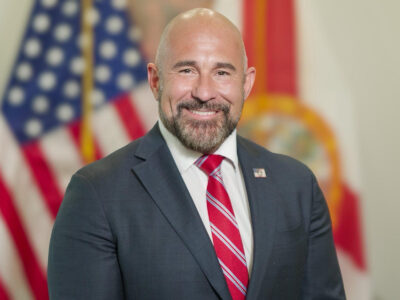
Lieutenant Governor Jay Collins is running in the Republican primary for Governor. Photo provided
Jay Collins
While Donalds hails from New York City, Collins is from Montana.
Collins said he “grew up very poor in a bit of a broken home. The American dream is alive and well,” Collins said.
A U.S. Army veteran, Collins was a Green Beret medic who served tours in Afghanistan and Iraq. A battle in Afghanistan with an enemy combatan led to him being shot and ultimately losing one of his legs. He was able to re-enlist after losing his leg, and left service as a first sergeant.
After his service, Collins moved to the Tampa area and was elected state senator. He was appointed as lieutenant governor last year by Gov. Ron DeSantis.
Collins was recently in Cape Coral, where he spoke about data centers. “It’s a concern everywhere,” Collins said. “Hyperscale data centers are something we should absolutely be concerned about. We have to know the facts and we have to protect our people in our state. Nobody wants to have power prices go up, nobody wants to see degraded water quality or access.”
Collins said he is concerned about power shortages, water shortages and price increases. He said he does not yet want to ban data centers, but supports the tactics taken by DeSantis, to focus on ensuring that bills wouldn’t go up where the data centers are built. “There should be no degradation of water quality,” or impacts on local aquifers, or else the data centers shouldn’t be allowed to be built, he said.
He said there also needs to be clarity and transparency as to who the customers are for the data centers. “I don’t want to see state overreach,” Collins said. He said the data centers should be decided by local governments.
Recently, in New York, there was a one-year moratorium put on data centers statewide.
Collins has also expressed concern about the use of Flock Safety cameras, which has become a growing issue in the state, as their use expands. The Lee County Sheriff’s Office utilizes Flock Safety cameras, and license plate readers, as does the City of Cape Coral Police Department.
“Nobody wants a police state,” Collins said. “Nobody wants to have cameras on ever corner, 24/7, 354,” Collins said. He said there is a concern about individual freedoms.
However, when used properly, Collins said the cameras can be effective in catching dangerous criminals.
“There are regulations and authorizations and you can’t have random people doing random things with it. It has to be used as intended, with strict guardrails and accountability. We can never trade our individual freedoms.
On the state referendum to increase the homestead property exemption up to $250,000, Collins said taxes in the state have increased too much. “We have a spending problem,” Collins said. Collins wants a trust fund to support fiscally-constrained counties in the bill, to “help offset that tax base.”
Collins said he does have concerns about fiscally-constrained counties being impacted by the loss of revenue.
“Overall, I believe it is not the government’s money, it’s the people’s money,” Collins said. “When you try to do something bold, people get scared.”
Collins said there are people worried that the property tax exemption could impact public safety and roads, but doesn’t think those concerns are founded. “We have plenty of money, we just have to be careful with the way we spend it,” he said.
Told Lee County is projecting a loss of more than $200 million in property tax revenue. Collins said “I would encourage you guys to go do the math on that.”
Collins he is proud of his political service in passing legislation for permitless carry, prayer in sports, education reform regarding the required teaching of how socialism and communism is taught in schools.
After Hurricane Ian, Collins volunteered throughout Southwest Florida in delivering meals. That included being on Fort Myers Beach to serve meals to the needy who had lost everything in Hurricane Ian. Seeing the destroyed Fort Myers Beach Pier after Hurricane Ian struck a nerve with him, as he said he had just visited the pier weeks before Hurricane Ian.
On whether he would forgive the state’s $11.9 million loan to the town, which was given by Gov. Ron DeSantis after Hurricane Ian to help the town’s operations, Collins said “I have not had those discussions so I can’t really weigh in one way or the other.”
Regarding the closure of the Fort Myers Beach Elementary School, Collins said “we all care about the schools. I don’t have the details. It’s not something that was in my purview. It’s something I am happy to check into.” Fort Myers Beach Mayor Dan Allers had appealed in a letter to DeSantis last year for help reopening the school, though the governor never responded.
On the funding of public schools and the ongoing lawsuit by the state teachers union against the state challenging the state’s funding of public schools, Collins said his children attend public schools. He supports school choice. “It’s fundamentally a good thing but we need accountability as well,” Collins said.
“We have to make sure that everyone is competitive. The money follows the child,” he said. Collins said he would prioritize school choice as governor.
In the School District of Lee County, where an operating deficit of more than $40 million exists and hundreds of staff members were expected to have been laid off after the end of the school year, Collins said he would need to examine those details. DeSantis visited the school district in May, in which he attacked teacher unions.
On the topic of development, Collins said “I am a limited pre-emption person. I don’t like to pre-empt anymore than I have to. Nobody wants to see overgrowth. We have to maintain our farmland, we have to maintain our waterways, our beaches, our green zones. That is what makes Florida what they are. Likewise, we do need pro-business approaches,” Collins said. Collins said he wants quicker permitting with less permit fees for developers.
“That is the best way to keep overgrowth from being an issue,” Collins said.
Collins said that in regards to the threat to the Florida panthers from developments in Lee County and Collier County, “I think we have done a very good job.”
Collins said “obviously I am on board with protecting what we have.”
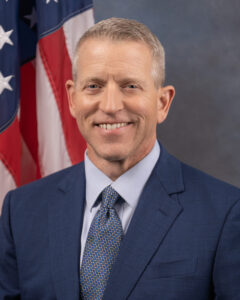
Former Florida House Speaker Paul Renner is running in the Republican primary for Governor. Photo provided
Paul Renner
For former Florida Speaker of the House Paul Renner to succeed Gov. Ron DeSantis, he will first need to mine through a ield of 10 candidates in the Aug. 18 Republican primary.
That job will at least be safer than the mine-sweeping work he did in the U.S. Navy during Operation Desert Storm 35 years ago, and his military service in Afghanistan 20 years later after being called back into service with the U.S. Navy Reserves.
“I am very proud to have served and I was privileged to have served. I loved the men and women I served with, and I wouldn’t trade it for anything,” Renner said.
Now, 59, Renner is seeking to re-enter politics at the highest state level after being term-limited out of his state legislature seat last year. After leaving office, Renner was appointed by DeSantis to the Board of Governors for Florida’s State University System. Renner served as speaker of the State House for three years, while representing Flagler County in northeastern Florida. Flagler is an attorney and former state prosecutor.
On the campaign trail for governor, Renner said voters are telling him that the main issue on their minds is the cost of living.
“Affordability is very much a top issue,” Renner said. Cutting property taxes, tackling electric rates, and property insurance costs are two of the ways Renner thinks he can make a difference in the pocketbooks of Floridians.
Renner wants to eliminate homestead property taxes up to $1 million of a property’s value. That would be substantially up from the proposal on the state ballot this November to make a Constitutional amendment to raise the homestead exemption from property taxes from $50,000 to $250,000 of a property’s value. The measure would not include school taxes, which Renner wants to see included.
Renner said he wants to take care of long-term residents with a five-year wait. To make up for the revenue loss to schools and municipalities, Renner said he would shift the burden to private equity investing in turning homes to property rentals, tourists and other visitors to Florida.
Renner said the largest revenue shift he is proposing would be a one-time fee on the purchase of a home or business.
Renner said he wants to also provide assistance to renters and businesses, who wouldn’t benefit from the homestead exemption.
To make up for the loss of revenue to municipalities and schools, Renner said the “state will have to help with this process” through state surpluses. He would like to see the state assist municipalities in financial in distress. Renner thinks the state can also find savings in Medicaid through going after “fraud, waste and abuse.”
Renner said he wouldn’t comment on whether he supports the current referendum. “I haven’t opposed it, I am not going to be out campaigning for it,” Renner said. “I am not against it. I think they could have done a much better job.” Renner said the proposed homestead exemption amendment “looks a little half-baked.”
Renner said he thinks the amendment “fails on two fronts. It fails on the benefit front not going far enough, to truly make sure you don’t lose your home if you get sick, lose your job or make a fixed income and can’t pay the property taxes.”
Renner said there is no backup in the bill for fiscally-constrained municipalities if they lose a catastrophic amount of property tax revenue. Lee County is forecasting more than $240 million in lost tax revenue for 2028. Renner said property taxes have gone up too far in Florida. “Government shouldn’t grow faster than our incomes,” Renner said.
Renner said Florida Power and Light’s request for a rate hike this year, which was partially granted, was an example of an issue he wants to tackle. Renner said he wants to slow the rate of utility hikes.
Hurricane Ian hit Lee County while Renner was Speaker of the Florida House.
“I did a lot during my two years of Speaker,” Renner said. “We delivered the greatest hurricane relief package in Florida history.” Renner said “I told people we were not going to forget about them.”
Asked about what he would do to help communities like Fort Myers Beach recover, where its elementary school has remained closed since Hurricane Milton, and the town is now preparing to take over the school and operate a charter school, Renner said he realizes that the recovery from Hurricane Ian is still continuing. “I realize that is not complete yet,” he said. Renner said there are municipalities in the Panhandle still recovering from Hurricane Michael. “I will finish the job to see that whatever needs to be completed, is completed,” he said.
On whether he would forgive the $11.9 million loan to Fort Myers Beach which DeSantis awarded the town after Hurricane Ian, Renner said he wouldn’t commit to that but would consider it.
“It could be,” Renner said. “I have got to look at the details of that and look at what happens with the property taxes and how they are affected by that. You want to be fair to everybody. You don’t want to keep raising the bar every time there is a hurricane where the state is going to come in and cover all of the costs either. A loan is not a grant.”
On the situation with the operating deficits that the School District of Lee County is going through, currently estimated at more than $40 million, Renner said the movement of students away from public schools into charter schools, and the movement of families out of Florida due to immigration issues, are changing the demographics of public schools.
“My role as governor is not to make sure that no school ever closes if a population is moving around and there is no demand for that school,” Renner said. “The best schools in Florida have a wait list.”
With the threat of overdevelopment being called a top issue by Lee County commissioner candidates, Renner says that is a top concern of his too. He called himself “a committed conservationist.” Renner is sensitive to data that has shown some of the development projects in Lee County, such as the Kingston development in Estero, and others in nearby Collier County, could lead to more deaths of the endangered Florida panther.
“I championed the Florida Wildlife Corridor. We spent more to protect and conserve Wild Florida including those panther lands than any legislature before or since, over $1 billion and counting. We put some money in recurring funds to continue to conserve land. I am committed to completing the Florida Wildlife Corridor and part of that means you are not building on it, you are preserving it.”
Renner said Floridians “don’t want to see the Florida they love paved over.”
Renner said he is also concerned about the state legislature taking too much power away from local governments.
“I am concerned about the issue of local control generally. I think the pendulum has swung too far in Tallahassee. We need to make sure we are not taking away the powers that historically have been left to local government,” Renner said.
“We have grown too far, too fast,” Renner said. He said he is committed to the Florida Everglades restoration, and called water quality a top issue of concern for him as well. “You can make the environment better through smart steps,” Renner said. “Once you destroy it, you don’t get it back.”
Renner is calling for a statewide moratorium on new AI data center construction to protect consumers, workers, and the environment. He pointed to rising energy demands, increased strain on water supplies, and the likelihood of higher utility costs as immediate concerns for Floridians.
“The push for AI Data Center developments is a reckless gold rush,” Renner said. “Big Tech and major utilities are pushing massive data center projects at a pace that outstrips oversight, transparency, and common sense. As Governor, I’ll stop it.”
While Renner’s service started in Operation Desert Storm, it didn’t end there. He left to enter the University of Florida Levin School of Law while also entering the U.S. Navy Reserves. After working as a state prosecutor and as an attorney in private practice, he was called back into active duty during the Iraq War to work out of Washington D.C., and served in Afghanistan in 2011. He retired from the U.S. Naval Reserves with the rank of commander in 2013.
Fort Myers Beach Observer Editor Nathan Mayberg can be reached at NMayberg@breezenewspapers.com