

Wyndham Garden Hotel development agreement approved by LPA
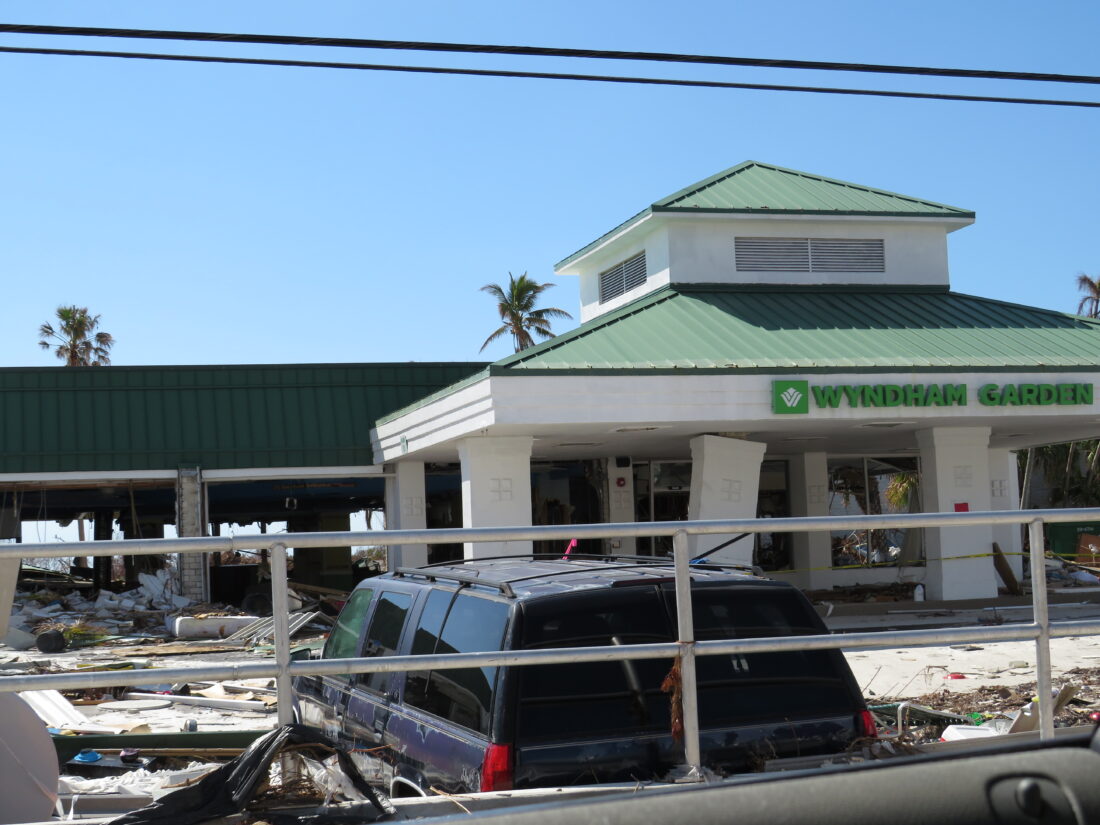
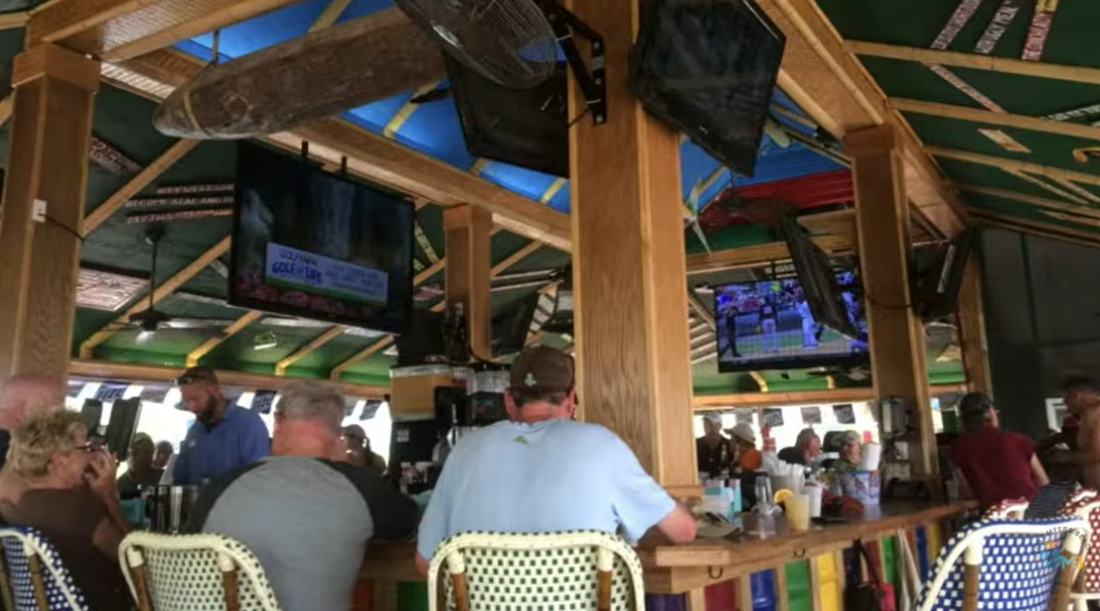
By a vote of 6-1, the Fort Myers Beach Local Planning Agency approved a development agreement for plans by the owners of the former Wyndham Garden Inn for a restaurant and tiki bar, with six mobile trailers at 6890 Estero Boulevard.
The property owners, FMBH LLC, presented plans for two phases. John Callis, representing the Pohlmann family, said the long-term intention is for a hotel to go on the site but the plans currently do not include a hotel use.
Local planning consultant Patrick Vanasse, of The Neighborhood Company, said the Pohlmann family sought a hotel operator for the site but that there was only interest from hotel operators in purchasing the site. The family has been seeking a hotel operator for the site, but do not want to sell the property at this stage.
“There was interest in the property,” Vanasse said. “There were people that would have been interested in buying it but didn’t want to partner. They wanted to buy it outright. That didn’t go for the family. The family wanted to maintain ownership,” Vanasse said
The second phase would include a wave dissipation wall, which the town has been calling a wave mitigation wall, and which many in the public commonly refer to as a seawall.
The second phase would also include the construction of a permanent restaurant structure, recreation area, pool and “lazy river.” The owners do not expect construction of the permanent restaurant structure to take place for at least another three years.
LPA member Jim Boan was the lone vote, citing his objections to a 24-hour overnight parking proposal for part of the property. The parking plans also received objections from neighbors at the Sand Caper. Members of the Fort Myers Beach Local Planning Agency said they had met with Vanasse ahead of the meeting to discuss the plans.
Boan also objected to the nature of the development agreement itself. “These development agreements have become something different than what we intended when we first discussed,” Boan said. “They were intended for those small moms and pops.”
The Town of Fort Myers Beach Council updated its development agreement process in 2024, and was the basis for its approvals of the controversial Seagate Development Group condo project,
The vote by the Local Planning Agency (LPA) in favor of the new plans at the Wyndham Garden Inn site is a recommendation to the Town of Fort Myers Beach Council, and includes seven deviations from land development code. The deviations include allowing the use of crushed shale and rock for the parking lot, instead of asphalt. The deviations also include a variance from buffer requirements, and to allow the joint use parking area for any business on the island with valet parking in phase two of the project.
The Town of Fort Myers Beach Council will still need to approve the development agreement.
As a public benefit, the owners are offering public beach access at the property. As a condition of that public beach access, town staff is requiring that the beach access goes to the mean high water line, said town planning consultant Jason Green.
Though the owner offered the public beach access, the LPA actually insisted that an approval is conditioned a requirement that there be no beach parking allowed at the property. LPA Chair Anita Cereceda sought to limit any parking on the site for only those who will go to the restaurant or tiki bar. Callis ultimately agreed to the condition.
The restaurant and tiki bar will be in the form of a tiki/pole barn structure with restaurant and ancillary uses to be provided via six mobile trailers and a recreation area.
Phase two of the plan calls for a Wave dissipation wall with the 5,000 square foot permanent restaurant structure within the tiki/pole barn structure and recreation area to include a pool and lazy river.
The old Wyndham Garden Inn was destroyed by Hurricane Ian in 2022. Once known as a Holiday Inn, the hotel dated back to 1969. At the time of Hurricane Ian, the hotel also had a Pinchers restaurant, and tiki bar, on site. The beach area behind the hotel has long been a popular spot for beach chairs and Jet Ski rentals.
“The Wyndham Garden always embraced the locals and the residents,” Vanasse told the LPA. The restaurant and tiki bar was open to the public. “It was a fun hangout for a lot of residents,” Vanasse said.
Vanasse said the family wants to “bring back that vibe, bring back those uses that people love.” Vanasse said they believe there is a need for a restaurant on the south end.
Vanasse said the owners may still decide to still build a resort. They would need to amend the development agreement or return to apply for Comprehensive Plan Development rezoning.
The 11.2 acre parcel is zoned for Commercial Resort, of which 3.8 acres is developable, landward of the Coastal Construction Line.
Wave wall
The most contentious part of the LPA’s review centered around the wave dissipation wall that was proposed for phase 2.
Vanasse called the wave dissipation a public benefit though LPA members and the Sand Caper expressed concerns for the proposed wave mitigation wall.
Vanasse made reference to the town’s ongoing study for potentially building a wave mitigation wall across the entire beach and London Bay’s plans for a wave mitigation wall at their proposed Outrigger Beach Resort redevelopment.
“There is a lot of conversation and speculation about the wave mitigation walls and zoning map change,” LPA member Jim Dunlap said. Dunlap asked Vanasse if there would be any issues with neighbors if a wave mitigation wall was put in, with a partial wall.
“This is not my expertise,” Vanasse said. Vanasse said the wave dissipation walls would not be “massive walls deflecting water. They are just a few feet. They can be exposed or they can actually even be covered in sand where you will just see a berm essentially. So low-lying, what they do is they break the velocity, the momentum. Flooding still happens on the property, water still goes there.”
Vanasse said they could design the wall to have a break in the wall to allow the flow. “It dissipates, the velocity allows the water to follow through.”
Dunlap said there has been a lot of talk about wave mitigation walls in town and he thought it was important that there be a public discussion on the record regarding the wave mitigation wall for the public to be aware of how it could impact the project. “Wave mitigation wall has become the new thing,” Dunlap said.
“I share some of Jim’s concerns relative to the mitigation wall,” Cereceda said. “Nobody likes to talk about what happens on either end of it. I know what it’s intended to do but I remember the first time I drove on the island you could see where seawalls were and the massive washout that occurred on the ends of those seawalls and it was terribly destructive,” Cereceda said. “That is a concern to me.”
Larry Gulleen, president of the Sand Caper Condominium Association, next door, also expressed concern about the impact of the proposed wave barrier. Gulleen referred to the seawall at Leonardo Arms, just down the road from their property. “When Milton came in, the associations on both sides were heavily hit. So we are concerned about the impact of that wave barrier upon our property, upon the wildlife area that’s there (Little Estero Island Critical Wildlife Area), and upon the berm that we spent so much money on.”
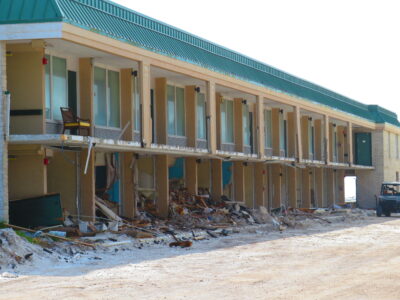
The Wyndham Garden Hotel stood as a hotel on Fort Myers Beach since 1969 until being overcome by Hurricane Ian. Photo by Nathan Mayberg
Gulleen said they don’t want the wave mitigation all going to the edge of their property line.
Noise and amplified music
Cereceda said another concern for her was on the noise impact. “That noise impact is going to be tremendous on the adjacent properties,” Cereceda said. Cereceda said that music played at the old hotel was surrounded by buildings, whereas under this new project there wouldn’t be protection for neighbors from the sound.
John Callis, representing the owners at the meeting, said there were sound impacts to the neighbors at the old hotel as well. “That sound bounced off the buildings like crazy,” Callis said.
Callis said there could be sound curtains that could be put up to mitigate the sound impacts from the entertainment and music at the site. He said he has put up sound curtains for pickleball courts to mitigate sound impacts.
Cereceda insisted that sound curtains be a condition of approval, which the applicant agreed to.
The restaurant’s hours would be from 7 a.m. to 9:30 p.m. Amplified sound was originally proposed from 10 a.m. to 9 p.m. After Cereceda consulted with Callis during a break, there was agreement to change the amplified sound hours from noon to 9 p.m.
LPA member Jane Plummer asked Vanasse if she believed FEMA would approve the six trailers, and asked if there would be room for a future resort based on the current plans. Vanasse said all of the trailers on site will be towable by a light duty truck.
Vanasse said he expects the whole site to be redesigned if there is a resort. “I think the whole site gets redesigned,” Vanasse said. “One day there might be another resort there,” Vanasse said.
Parking
Parking at the site was another bone of contention amongst LPA members and neighbors. Under phase 1, there would be 163 spaces. Contrary to nearly all of the major projects the town has seen since Hurricane Ian, that would actually be more than is allowed. According to Vanasse, they are required to have 144 parking spaces.
Vanasse said the owners also want a gaited parking lot with 36 spaces that is restricted to valet parking. Vanasse said the owners want to be able to use that parking to enter into parking agreements with other properties in town for joint parking agreements.
Vanasse referred to the Beach Theater, whose approval includes the use of offsite parking at the Dolphin Inn. If the owners of the Beach Theater were to sell the Dolphin Inn, they could enter into an agreement with the owners of the Wyndham property for overflow parking, Vanasse said. “We would allow valet parking and overnight parking for other properties that have parking deviations,” he said. Vanasse also cited Myerside Resort as another example.
On phase two, there would be 237 parking spaces, though Vanasse said the requirement is for 147. That is an excess of 90 spaces. “We had 200 parking spaces at the former resort,” Vanasse said.
Cereceda said there was concern from neighbors in the emails she received, regarding the parking proposal.
Larry Gulleen, representing the board of directors of the Sand Caper, said the association supported a proposed restaurant and proposed beach access, but objected to the parking plans, the wave wall and the buffers.
“We’re concerned that they shoved everything against the Coastal Construction Line to make more room for parking. If they shove everything back 30 feet, they don’t have to go over the Coastal Construction Line,” Gulleen said.
Gulleen said the association also has concerns about the beach and wildlife area, and the hours of the amplified music. Gulleen said that “is not keeping with a residential area. We tell our people to use earbuds and earphones on the pool and at their lanais.”
Gulleen said they didn’t mind the music in the evening, but that it was buffered by the old buildings.
Gulleen argued that the town can’t permit by code a series of accessory structures without a primary structure. The association supports the return of the hotel but expressed concern with the level of enforcement currently in the critical wildlife area to prevent such nuisances as unleashed dogs chasing nesting shorebirds, which is prohibited in town code. Gulleen said the association wants a no-pet policy like Bonita Beach.
Gulleen said the proposal would change the character of the neighborhood from before Hurricane Ian, where the hotel served the local community, as compared to the current proposal, which he believed would lead to more outsiders coming and going.
“We think this can be significantly changed,” Gulleen said.
Boan said the overnight parking request from the applicants was premature until they have a user listed. He questioned whether there would be 24-hour valet parking.
Cereceda questioned the use of overnight parking as well. Vanasse said there was overnight parking previously at the site.
Vanasse said the overnight parking would only be accessed by valet parking, who would access the overnight parking site by an e-bike or scooter. “I think we all know that e-bikes and scooters changed for the whole game,” Vanasse said.
Boan questioned how the applicant could seek overnight parking for a hotel, which they haven’t been given approval for.
Vanasse used Myerside Resort as an example. Vanasse said this parking lot could be used to benefit other hotel sites in town. He cited the use of the Dolphin Inn for overflow parking for their Beach Theater property.
“All we get is roadblocks,” Vanasse said in response to objections from the Local Planning Agency.
Green suggested the Local Planning Agency be weary of approving projects throughout town that require more demand for parking without requiring enough parking on site.
Dunlap and board member Edward Schoonover said they didn’t object to the overnight parking. Schoonover said the town needed a 24-hour parking site. “This discussion has gone on too long for me,” Schoonover said. “The 24-hour parking is not a problem for me.”
Cereceda said she believed there was enough support on the board for the overnight parking so she would allow it.
Max Forgey, of Forgey Planning LLC, spoke on behalf of the Sand Caper, and said the proposed development is inconsistent with the town’s Comprehensive Plan. Forgey said the 237 parking spaces proposed doesn’t promote the small-town character that the town’s Comprehensive Plan seeks to protect.
Boan said he supported a traffic study, which is also a staff recommendation. He also wants county review, in case another lane is needed on Estero Boulevard to support a turn-in lane.
Boan also objected to a proposal by the applicant which he interpreted to bypass a public hearing for the board’s future review of a permit for a hotel. Boan said he found that “unacceptable.”
The language in the development agreement he referred to stated “the property owner and developer retains the right to build a commercial resort consistent with the Land Development Code and 2045 Comprehensive Plan through the development order and/or building permit process without the need for a public hearing. However, any future proposed development of a commercial resort not in compliance with the existing regulations shall require an amendment of this Agreement before Town Council.”
Vanasse said the owners would still need to go back to the LPA if they seek to develop a hotel.
If the construction of phase two of the project has not commenced within five years, the developer must provide written notice to the town requesting extension or modification, or termination of the plans.
The Town of Fort Myers Beach Council is expected to take up review of the plans in August.