

Tough year for turtles on Fort Myers Beach
It could have been one of the great nesting years on Fort Myers Beach for loggerhead sea turtles. Unfortunately, a mixture of disorientations from lighting violations and washovers of nests from storms, and the indirect effects of the town’s beach renourishment program, led to large losses of eggs and hatchlings.
There were 113 loggerhead sea turtle nests on Fort Myers Beach this season, the second-most on record.
Yet so many things went wrong that led to deadly outcomes for many of the hatchlings on top of conditions that prevented many of the eggs from hatching.
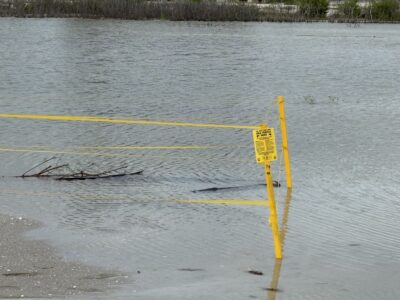
Of the 113 sea turtle nests, the eggs in 31 of the nests didn’t hatch at all due to either being washed over or washed away completely. Of the 113 nests, half were considered to have been washed over to some extent, meaning the nests were negatively impacted by runoff from summer storms to the extent that at least some eggs inside did not hatch due to the water damage.
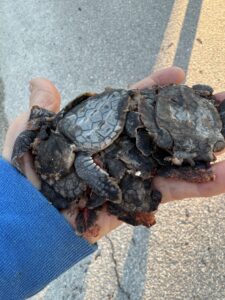
For the hatchlings who did leave their nests, 29 of the nests disoriented. That means some of the hatchlings, and in some cases nearly all, turned in a different direction away from the Gulf when leaving their nests. Instead of following their natural instinct into the water, they followed light objects that ended up putting them onto Estero Boulevard, into sewer drains, pools and inside the electrical rooms of condo buildings. Their journey in most cases led to death from starvation and dehydration, or to getting crushed by vehicles on the road, or to predation from large birds.
Turtle Time founder Eve Haverfield knew it was going to be a tough year to begin with due to the town’s beach renourishment project running past its expected completion date. The project, which started in the summer of 2024, was supposed to be finished by January. Instead, it ran into the bird-nesting season and well into the sea turtle nesting (which began in May) due in part to equipment failures on the part of the contractor.
The beach renourishment project meant that Haverfield and Turtle Time volunteers would need to move 44 nests out of harm’s way so as to not get covered by the beach renourishment project and to avoid the nests from having to be interfered with by the pipes that ran along the island.
“Considering all of the trials and tribulations the nests had to deal with, it was good,” Haverfield said.
“Nest-wise, we were higher than we expected,” Haverfield said. “The hatchling percentage was not great.”
The 113 recorded nests were second-most to the 132 nests recorded in 2020.
As loggerhead sea turtles typically nest every other year, this is the year Turtle Time and Haverfield expected Fort Myers Beach to see less nests than the year before. Last year, there were 109 nests and the year before there were 71. In a reversal from norms, this year there were 113 recorded nests, beating out the 112 nests recorded in 2019 for second place.
Half of the nests this year were washed over and five were washed away completely. Of the 113 nests, 44 were relocated due to the beach renourishment project. Haverfield said the relocated nests did fairly well though one completely disorientated toward the Seawatch timeshare building, Haverfield said,. The building was violation of the town’s turtle lighting code for months though it eventually took down one of the main sources of uplighting on its property in September, late in the nesting season.
In total, out of the 9,856 eggs that were laid on Fort Myers Beach by loggerhead sea turtles this year, only 5,465 (44%) hatched due to water infiltration.
“We had some very huge areas of pooling,” Haverfield said. “Some nests were kind of low.” Haverfield said Turtle Time can’t move nests once the beach renourishment work has been completed for at least a year due to state law. That means that while Turtle Time was successful in moving nests before the beach renourishment work started, they couldn’t move nests that were threatened by pooling and being in low-lying areas of the beach near the high tide line where beach renourishment had already begun or was completed.
“Those nests didn’t do well,” Haverfield said. “There were significant areas of pooling.”
If it weren’t for Turtle Time being there to relocate the nests that were endangered by the beach renourishment project, the outcome could have been a lot different.
“It could have been much, much worse,” Haverfield said. “The volunteers were just amazing out there.”
While the 5,465 eggs that did hatch might sound like a lot, somewhere between one and four out of every 1,000 hatchlings will make it to adulthood (roughly the age of 30).
That means only about five to 20 of the 5,465 eggs will reach sexual maturity. The young turtle hatchlings face many challenges in the Gulf from predators such as sharks and other dangers such as boat strikes.
While Fort Myers Beach is exclusively the nesting habitat for loggerhead sea turtles, nearby Sanibel and Captiva get visits from green sea turtles, las well as loggerheads. The conditions and location of the beach differs as well as the diet of the turtles.
On Sanibel and Captiva this year, there were 868 loggerhead nests recorded and 21 green turtle nests recorded.
At nearby Lovers Key State Park on Fort Myers Beach, where sea turtle nesting activity is documented by the Florida Department of Protection (DEP), there were 40 loggerhead sea turtle nests recorded this year. Of those, 33 successfully hatches. Six were lost to washouts or predation, and one failed to hatch, according to DEP spokesman Chip Turner.
Last year, Lovers Key had a total of 43 nests last year, but hurricanes Debby, Helene and Milton caused significant washouts, and 32 nests were lost, Turner said.
There were 317 false crawls on Fort Myers Beach this year compared to 238 last year. That is also believed to be due to the town’s beach renourishment project, as piping that stretched across the island discouraged turtles from going forward.
Despite all of the obstacles turtles and Turtle Time faced this year, Haverfield is being optimistic. After all, when she started Turtle Time in 1989 there were far fewer nests and so many turtles dying on the roads. The number of sea turtle nests this year was more than triple the number of nests in 1996, when there was just 30 counted.
Haverfield is hopeful that the vegetation that has been placed by the town in the last few months as the next step in the beach renourishment project will help trap the sand in place and help prevent some of the pooling that was witnessed this summer.
“I am thrilled with the dune vegetation. It does provide a buffer,” Haverfield said.
Haverfield said the dune vegetation will attract sea turtles who seek to nest there, on elevated ground. “It’s good for turtles,” she said.
“We are thankful for all of the cooperation from all the guests and the residents who tried to be turtle friendly,” Haverfield said.
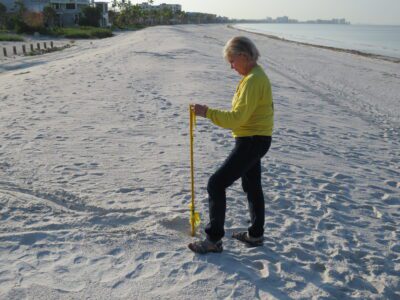
Turtle Time founder Eve Haverfield. Photo by Nathan Mayberg
All of these years later, Haverfield is still trying to get all of the island, including guests, visitors and residents, to turn their outdoor lights off after 9 p.m. during turtle season and to close drapes and curtains. Haverfield encourages all homeowners to obtain amber LED lights for their outdoor lights, which she said is “economically advantageous” as well as turtle-friendly. “LED lighting is cost effect. It’s a win-win situation,” Haverfield said.
Each season, Turtle Time passes out 10,000 pamphlets to residents and visitors at the beach and at condo buildings to remind them about complying with turtle season lighting regulations and to pick up after themselves on the beach.
Haverfield has been working with town officials on continuing to address the lighting issues. Enforcement of the town’s sea turtle lighting code dropped off significantly in recent years, corresponding to a record number of disorientations. Haverfield has seen responses from the new administration in town that lead to believe there will be improvements next year in enforcement and proactive responses.
Town of Fort Myers Beach Publinc Information Officer Abigail Eberhart said that for a town recovering for hurricanes “we have to balance residents’ ability to recover, rebuild, and regain financial stability with the protection of the wildlife that is so essential to our beautiful island and ecosystem.”
Ebarhart said “This year has really been about education for us. We want residents and businesses to clearly understand lighting specifications and have the resources they need to take action. Our goal is for this to remain a positive and collaborative initiative. As our Town Manager, Will says, “At the end of the day, we are all community partners working toward positive outcomes for our sea turtles. We share this beautiful island with the turtles, and we want successful hatchings and proper orientation. We see this as a communitywide effort.”
At a recent Town of Fort Myers Beach Marine and Environmental Resources Task Force meeting, Environmental Projects Manager Chadd Chustz said he recently attended a conference a sea turtle workshop at the University of Florida in Gainesville as part of an invitation from staff from the Florida Fish and Wildlife Conservation Commission (FWC). Chustz said he learned about how other municipalities are dealing with enforcing codes related to sea turtle nesting, including the technicalities of doing light assessments and using a spectrometer to assess lighting. “I learned a while lot,” Chustz said. He said he would be sharing more information from the workshop when FWC releases presentations. The town’s enforcement of turtle lighting violations through the issuance of citations has dropped off markedly since a change in town management in 2022. Last year, for example, there were only a handful of formal citations issued as compared to 2022 when the town issued 44 citations and more than 200 warnings.
Turtle Time would like to see the town be able to root out lighting violations that are already known to exist before the next turtle season begins, as a number of turtle lighting violations had already been known to the town before the last turtle lighting season.
“I am very hopeful,” Haverfield said.