

FWC report calls on Margaritaville to adjust lighting to avoid negative impacts to sea turtles
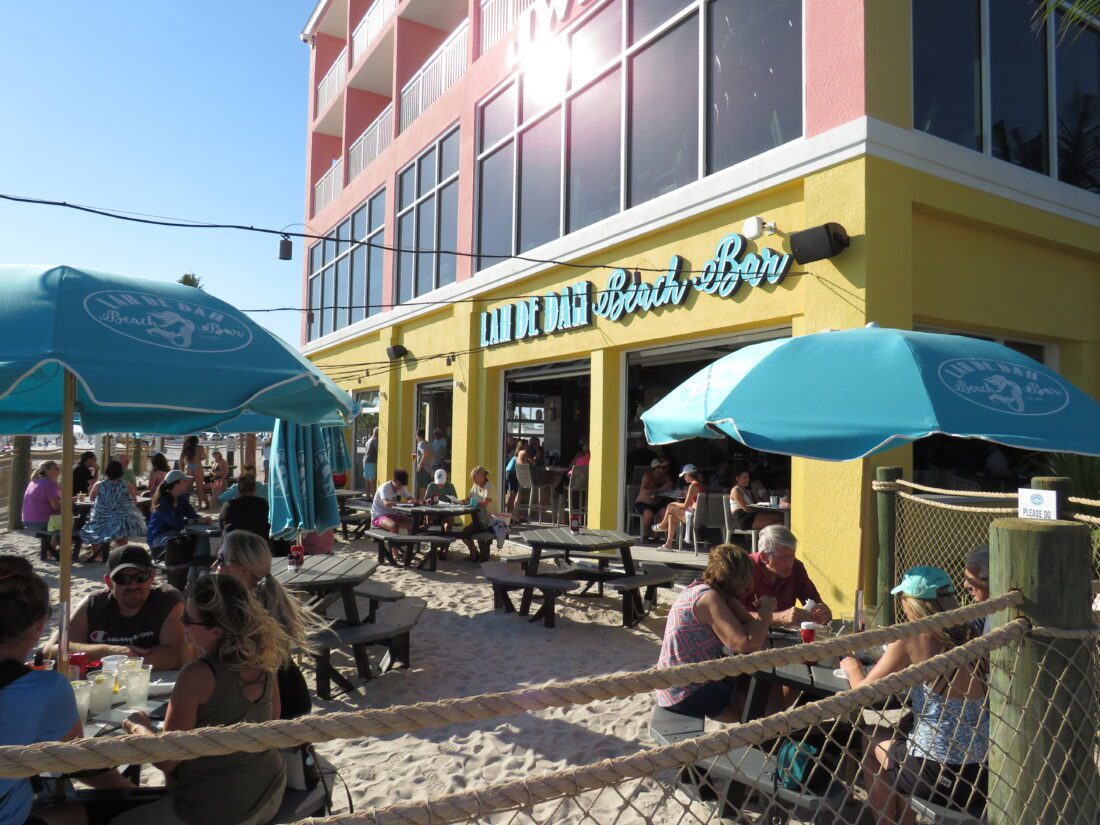
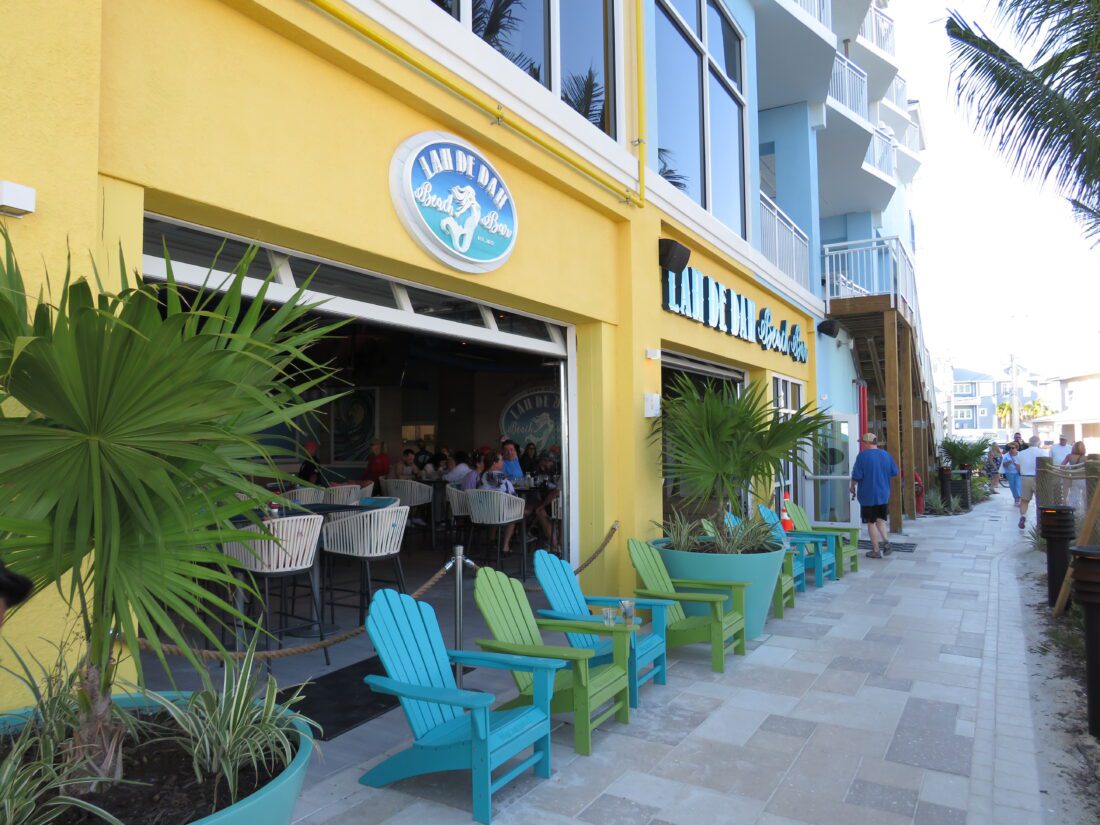
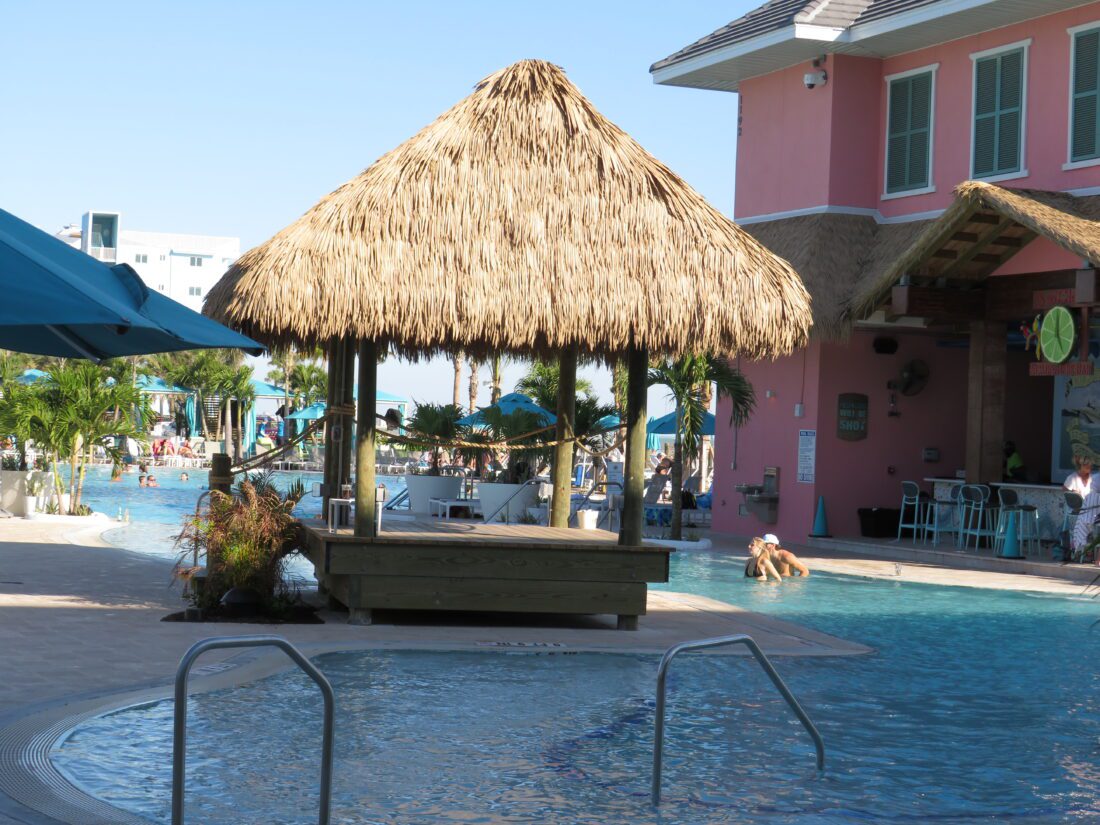
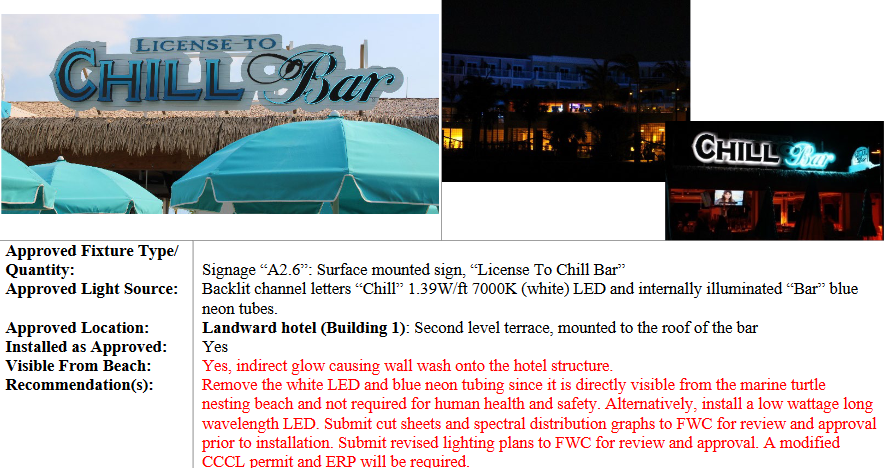
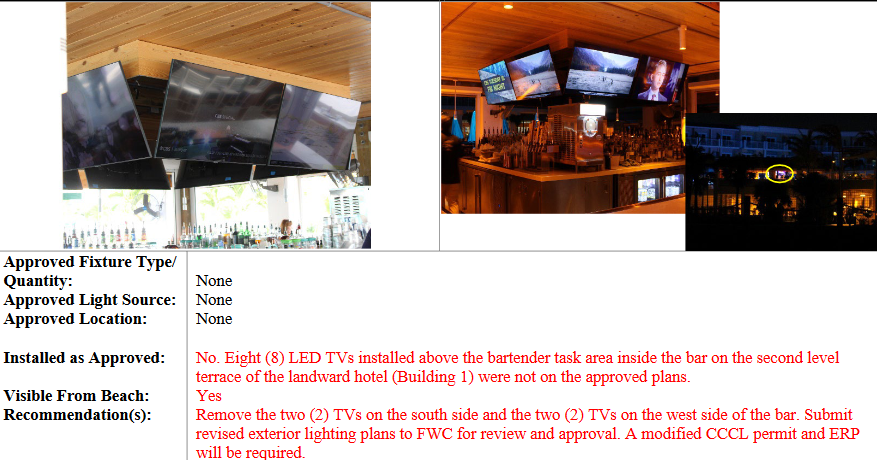
A 50-page marine turtle impact review by the Florida Fish and Wildlife Conservation Commission found that the Margaritaville Beach Resort needs to make numerous changes to its lighting to avoid negative impacts to the threatened sea turtle nesting population on Fort Myers Beach. The report found that in some cases the resort did not follow agreed upon-plans with the state.
The 87-point inspection includes 51 corrective actions regarding lighting, including several at the resort’s restaurants and bars. The report makes several mentions of the 9 p.m. cutoff time for when lights such as those from television sets should be turned off. That is the time at which the Town of Fort Myers Beach turtle lighting ordinance goes into effect, prohibiting unshielded, outdoor lights until 7 a.m. from May 1 through Oct. 31. The ordinance requires windows to be blinded to avoid light from inside being visible to nesting and hatching sea turtles so they aren’t disorientated.
The beachfront resort, which opened last December, held a site visit with the FWC in April. The visit was to determine if the lighting on site met the FWC recommended and the Florida Department of Environmental Protection and South Florida Water Management District permitted special conditions.
Tom Torgerson, chairman of TPI Hospitality and who helped develop Margaritaville on Fort Myers Beach, said the resort recently had to cover up four television sets at the License to Chill Bar to comply with the FWC report. Torgerson said he is trying to work with the FWC on compromises.
“It’s a lot of work but my fingers are crossed that we will be in agreement with the few compromises that we submitted and alternate approaches,” Torgerson said. “The TV situation though makes no sense to us and apparently others.”
The FWC report makes mention of several other television set issues and calls for turning off all lights for the television sets and digital menu board no later than 9 p.m. (when the town’s turtle lighting ordinance goes into effect) or to close the shutters at 9 p.m. so lights will not be visible from the marine turtle nesting beach.
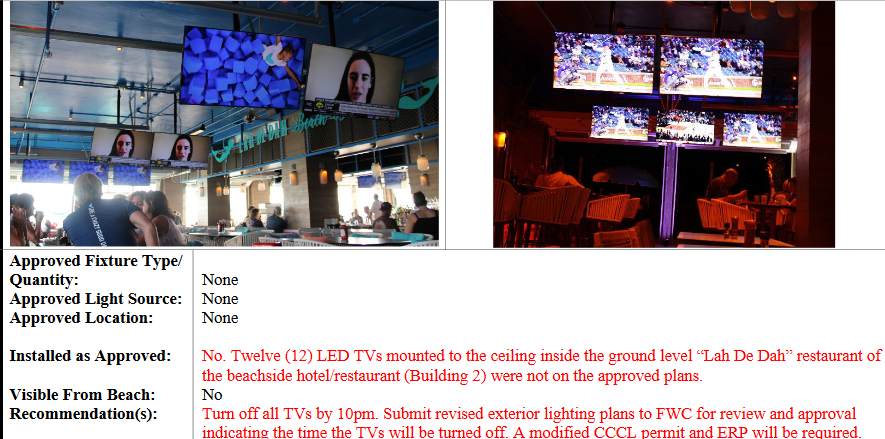
A dozen LED TVs mounted to the ceiling inside the ground level beachfront Lah De Dah restaurant were not on the approved plans. The FWC corrective action report calls for turning off all the televisions by 10 p.m., submitting revised lighting plans that indicate when the televisions will be turned off.
The report refers to eight LED televisions installed above the bartender task area inside the bar on the second level terrace of the landward hotel that it says were not on the approved plans. The FWC ordered four of the televisions to be removed.
Another two LED televisions installed in the seating area near the Coconut Telegraph Coffee Shop on the second level terrace of the hotel were also not in the FWC’s approved plans, according to the report. A revised exterior lighting plan is requested.
In addition, four LED TVs/digital menu boards installed in the Coconut Telegraph Coffee Shop facing the beach on the second level terrace of the hotel were not on the approved plans. The FWC ordered that all the lights are turned off after 9 p.m. or that the shutters are closed at 9 p.m. so those lights won’t be visible from the beach.
The FWC also requested revised exterior lighting plans for review and approval indicating the time the lights will be turned off or shutters will be closed.
Although several of Margaritaville’s bars are open past the 9 p.m. cutoff for when the town’s ordinance calls for outdoor lights to be turned off, blinds are closed to avoid any light from reaching the beach, Torgerson believes the hours for the bars are good for year-round.
According to Margaritaville Beach Resort’s website, the License to Chill Bar is open until 11 p.m. The Lah De Dah Beach Bar & Grill is open until 11 p.m. The 5 o’Clock Somewhere Bar & Grill is open until one hour past sunset.
In the FWC report, many of the resort’s lights are found to be visible from the marine turtle nesting beach. Among other corrections, the FWC wants the resort to install drop-down beachside shields on wall-mounted light fixtures to avoid visibility from the beach for nesting sea turtles.
“We have made significant changes already to lighting and the next wave of changes will be determined after FWC responds to our proposal to satisfy them,” Torgerson said.
Among the FWC’s other proposed corrective actions are for new revised plans for exterior pool lights. The report calls for the tinting of the garage style doors of the ground-level beachside Lah De Dah restaurant to be adjusted to 30-34% and for a modification of the CCCL permit.
Mason jar lighting on the columns and mounting fixtures of the Lah De Dah restaurant which faces directly across from the Gulf of Mexico were found to not be opaque in accordance with plans to shield the lights inside.
LED lights in all fixtures are to be replaced with a red LED, including above the elevator in the beachside pool bar and in the pool deck restroom structure.
Even lighting for liquor bottles in the resort’s bars were found to be visible from the beach and have been ordered to be removed.
Concernings FWC’s findings regarding nestings on the beach, Torgerson said “I am told no one knows of ever that a turtle chose to nest in our downtown beach area.”
Turtle Time founder Eve Haverfield cited two recent examples.
“This season, we documented two nests immediately to the south of the Margaritaville pool area, in front of where Margaritaville stores their tractors and beach furniture,” Haverfield said. “Because of the renourishment project, those nests were relocated. The construction of the berm last year provided suitable nesting habitat where in previous years only a narrow area of beach was available and that flooded frequently making it unsuitable for sea turtles seeking nesting sites.”
Haverfield said there were 11 loggerhead sea turtle nests found north of the Fort Myers Beach Pier this year. Loggerhead sea turtle nesting activity is protected by the Endangered Species Act as well as state conservation laws.
In a statement issued by Torgerson regarding the FWC lighting report through an emailed text message, he said “Margaritaville is doing its best to negotiate with (the) Florida Department of Environmental Protection (FDEP) and FWC but feels we are being singled out and being ordered to negatively adjust our facilities and operations in ways that aren’t and have never been imposed upon anyone else in Southwest Florida.”
Bradley Johnson, Florida Fish and Wildlife Conservation Commission Public Information Officer, said the FWC’s lighting inspection was to “verify fulfillment of the agreed upon and approved lighting plans associated with the site’s permits. During this inspection, staff identified inconsistencies with the approved lighting plans which could result in potential adverse effects for nesting sea turtles and their hatchlings. Discussions with the property’s representatives are ongoing and a variety of minimization measures are being assessed as we proceed through the permitting process.”
Sea turtles, which are considered threatened in the United States, are vulnerable to being disoriented by lighting. In order to protect sea turtles, Florida has instituted conservation laws that are in effect at all beaching communities where sea turtles nest.
“Sea turtles are the most well-known species of reptiles that are negatively affected by artificial light,” Johnson said. “Female turtles nest on subtropical and tropical beaches around the world. About two months later, the hatchlings burst from the nest and move towards the brightest horizon. On a natural beach, this is toward ocean and gulf waters due to the brighter night sky over the water and away from the shadowy dune. Artificial lights cause a problem for hatchlings because they lead the small turtles away from the safety of the water, where they succumb to dehydration, predators, or even being run over by cars. Lights also affect nesting females, which may spend valuable energy moving toward lights and away from the water, instead of returning to the sea after nesting. Nesting females have also been attracted to roads where they have been hit by cars. The loss of a female who has, against the odds, made it to reproductive age is a significant loss to these threatened and endangered populations,” Johnson said.
“We feel the demands exceed a healthy balance of mutual respect between human and turtle habitat on Fort Myers Beach,” Torgerson said. “We are staunch supporters of marine and wildlife habitat but at some point the asks or demands exceed what is logical to protect the turtles.”
Fort Myers Beach Observer Editor Nathan Mayberg can be reached at NMayberg@breezenewspapers.com