

Council authorizes license plate readers, cameras
Fort Myers Beach Council approves license plate readers for bridges as well as mobile cameras
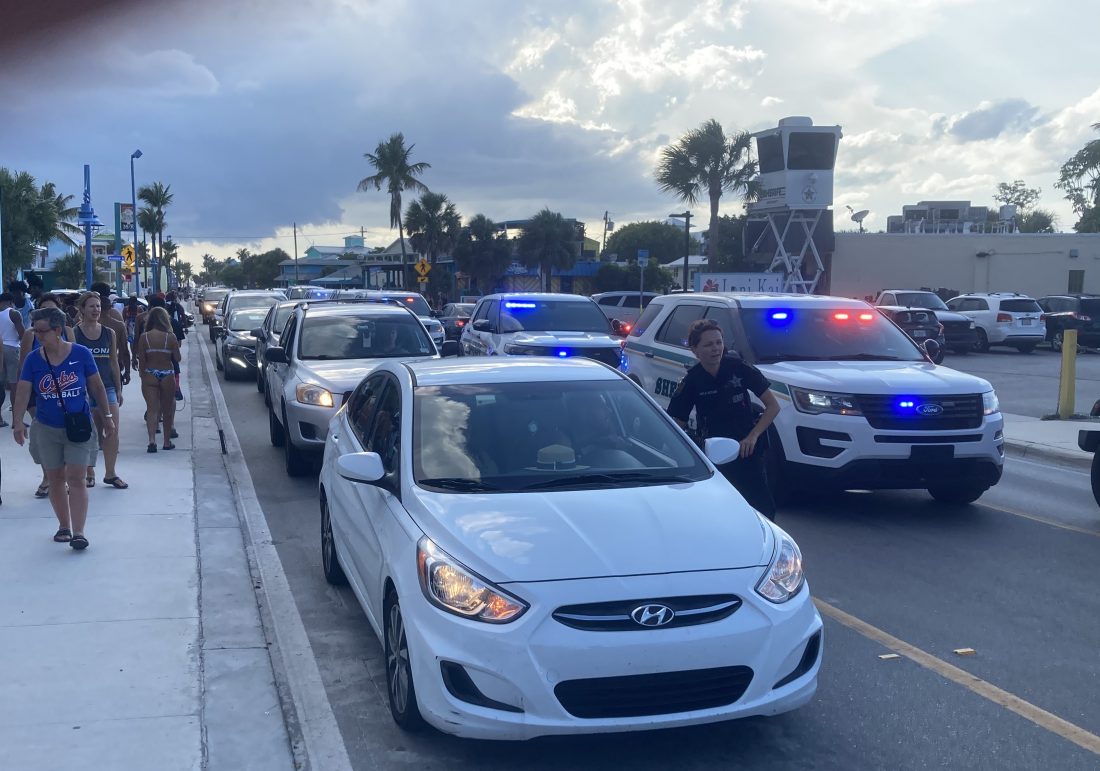

The Town of Fort Myers Beach Council has authorized Town Manager Roger Hernstadt to contract with Flock Safety to purchase six automatic license plate recognition cameras, which will cover the Matanzas Pass Bridge, Big Carlos Pass Bridge and give the town two mobile cameras that can be moved around town.
Todd Troutman, a representative of Flock Safety, told the council in October that the cameras focus on reading license plates and the data is stored for 30 days and would be kept by the Lee County Sheriff’s Office. Troutman said the data is also shared between other police agencies.
Flock Safety currently works with the Lee County Sheriff’s Office and Troutman stated his company would work with the Lee County Sheriff’s Office on the use of the cameras and that the data from the cameras would be shared with other law enforcement agencies.
Hernstadt said the cameras on the bridges would focus on cars on the road as well as the sidewalks. He said the town would work with Flock Safety and the Lee County Sheriff’s Office in identifying other locations for the cameras.
The town’s procurement of the cameras follows a couple high-profile criminal incidents over the past 18 months on Fort Myers Beach including an unsolved murder in 2020 and the apprehension of an Alabama man who fled after shooting during a scuffle on the beach where nobody was struck.
Hernstadt recommended the town move forward with Flock Safety, which is currently a vendor with the Lee County Sheriff’s Office. Another company that had made a proposal to the council, Greenwire Technology Solutions, had proposed cameras that would be able to zoom in hundreds of feet away on locations and be live-streamed into the Lee County Sheriff’s Office. That company had not yet made a proposal to the town as of the council’s last meeting Dec. 8, Hernstadt said.
Councilmember Dan Allers suggested the town get more cameras.
“I would prefer to have more than less,” Allers said. “As someone who works in the industry and works with cameras all the time, I can tell you there is no such thing as not enough or too many,” Allers said.
Allers suggested cameras be considered at Publix, Santini Plaza, Bowditch Point Park and other locations with high traffic.
“Those are all good suggestions,” Councilmember Jim Atterholt said. Atterholt said he would like to hear the priorities of the Lee County Sheriff’s Office.
“The question is do you want to have one mid-island and perhaps capturing what is going on (at) Old San Carlos Boulevard, Estero,” Hernstadt said. Hernstadt said the cameras are “very mobile” and can be moved to other places identified by the Lee County Sheriff’s Office.
“These are fairly inexpensive for what they are going to be doing,” Allers said.
Councilmember Bill Veach said the cameras will allow authorities to know “if a bad guy comes on the island, you know they are on the island or a wanted car.”
The use of license plate readers by municipalities has been challenged by the New Civil Liberties Alliance, which filed a lawsuit against the City of Coral Gables over Fourth Amendment constitutional protections against warrantless searches. The lawsuit contended that cameras were set up at every major intersection and allowed for the tracking of a person’s movements. The data was also shared with dozens of other agencies.
The organization filed an appeal of a Miami-Dade Circuit Court ruling in the state’s Third District Court of Appeal this month.
Jared McClain, an attorney with the New Civil Liberties Alliance, said the organization’s concerns with license plate readers is their use by law enforcement to store information on the travels of citizens particularly through the sharing of such data with other agencies.
The automatic license plate readers amount to “warrantless surveillance,” he said. McClain said the growing use of automatic license plate readers violates Fourth Amendment protections from unwarranted searches and Florida’s right to privacy from government intrusion under Article 23 of the state constitution.
McClain said that in the Coral Gables case it was found after discovery motions that more than 106 million images had been collected through the surveillance system yet he said there were few major successes in solving crimes through the cameras.
McClain said there is a potential for citizens being pulled over based on an alert system that could be triggered through the camera system based on incorrect data through the camera and data-sharing system which doesn’t update older data such as an expired registration.
The organization is looking into bringing another case in Florida over such cameras, McClain said.
Privacy issues regarding the use of the cameras had been raised by Atterholt at an October meeting though not such concerns were raised on Wednesday when the council authorized their purchase.
Lee County Sheriff’s Office Capt. Anita Iriarte confirmed the department currently partners with Flock Safety and said the department is currently in conversation with town staff to form an agreement regarding the use of the cameras.
Iriarte said the department has a policy regarding the use of data from the cameras “that correlates with state statute.”
Despite statements from Flock Safety that the data would be shared with other law enforcement agencies, Iriarte said the department does not share the data. “It’s for our internal use.”
Iriarte said that data from the cameras is used for “law enforcement purposes, special investigations, missing persons or safety reasons.”
The town opted to pursue the cameras after passing on signing on to the Lee County Sheriff’s Office community policing program, which would have cost more than $200,000 annually.
According to town documents, each “Flock Falcon Camera” will cost the town $2,500 ($15,000 for six) plus a $250 implementation fee for each camera for a total of $16,500. It is not clear what the annual costs for the cameras will be based on the quotes.
According to the town documents, the cameras will be used for “evidence, real-time alerts to police and for high traffic areas,” according to a quote from Flock Safety.